
300-920 · Question #18
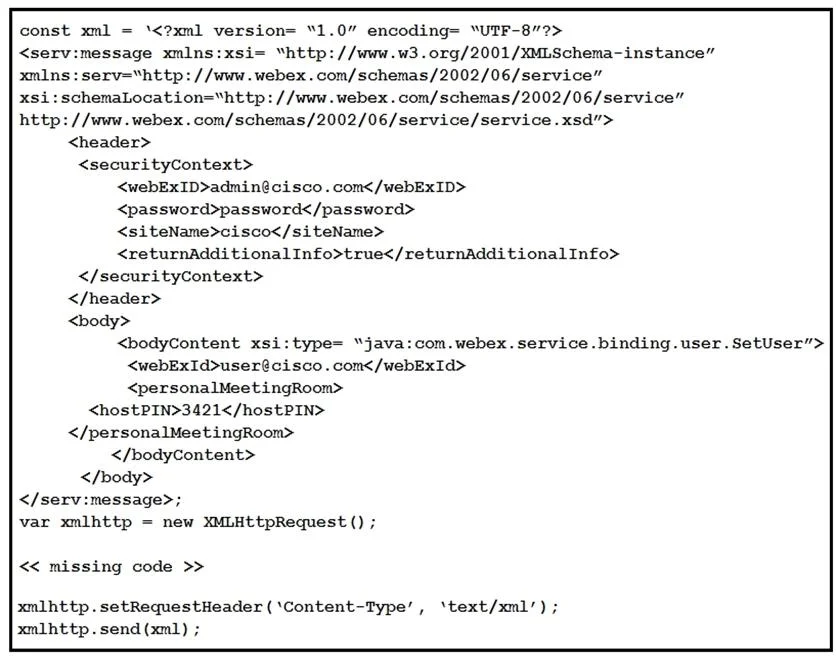
Refer to the exhibit. A developer must construct an HTTP Request to use the XML API to set a Personal Meeting Room PIN for a given user. Which code completes the code to create the request?
The correct answer is D. xmlhttp.open("POST", "https://cisco.webex.com/WBXService/XMLService"). D is correct because the Cisco Webex XML API uses POST for all operations - reads, writes, and updates alike - because the action type (e.g., SetUser to configure a PIN) is encoded inside the XML request body, not communicated via the HTTP method. The URL…
Question
Exhibit
Options
- Axmlhttp.open("GET", "https://cisco.webex.com/WBXService/XMLService");
- Bxmlhttp.open("PATCH", "https://cisco.webex.com/WBXService/XMLService");
- Cxmlhttp.open("PUT", "https://cisco.webex.com/WBXService/XMLService");
- Dxmlhttp.open("POST", "https://cisco.webex.com/WBXService/XMLService");
How the community answered
(27 responses)- A11% (3)
- B15% (4)
- C4% (1)
- D70% (19)
Explanation
D is correct because the Cisco Webex XML API uses POST for all operations - reads, writes, and updates alike - because the action type (e.g., SetUser to configure a PIN) is encoded inside the XML request body, not communicated via the HTTP method. The URL https://cisco.webex.com/WBXService/XMLService is a single endpoint that handles every XML API call this way.
A (GET) is wrong because GET cannot carry a request body, and the XML API requires sending an XML payload containing credentials and parameters. C (PUT) and B (PATCH) are REST conventions for full or partial resource replacement, respectively - the Webex XML API is not a REST API and ignores those semantics entirely.
Memory tip: Think of the XML API as a "one-door building" - no matter what you need to do (get info, set a PIN, delete a user), you always knock on the same door the same way (POST to the same URL), and you write your request on a note (the XML body) that explains what you actually want.
Topics
Community Discussion
No community discussion yet for this question.