
300-615 · Question #250
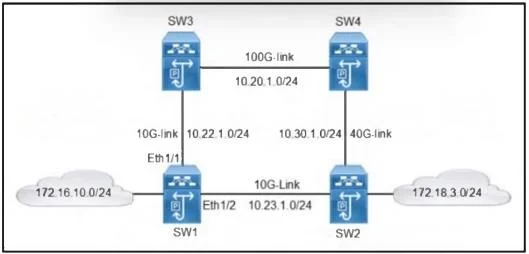
Refer to the exhibit. A network engineer configured Cisco Nexus 9000 Series Switches to allow the traffic between 172.16.10.10/24 to 172.18.3.100/24 to pass through the 100G-link, but it fails. SW3…
The correct answer is C. interface eth1/1. The issue here is related to OSPF cost. OSPF chooses the path with the lowest cost, and the cost is determined by the bandwidth of the link. By default, OSPF will prefer lower-cost paths for routing decisions. In the provided scenario, you want the traffic to pass through the…
Question
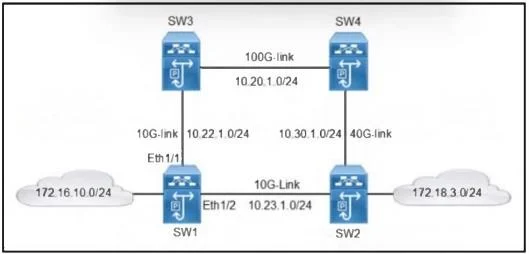
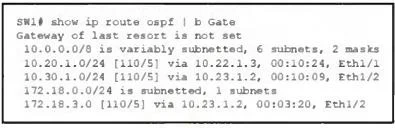
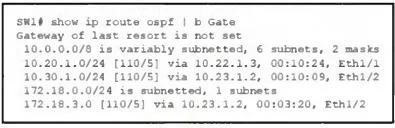
Refer to the exhibit. A network engineer configured Cisco Nexus 9000 Series Switches to allow the traffic between 172.16.10.10/24 to 172.18.3.100/24 to pass through the 100G-link, but it fails. SW3 and SW4 are configured with the default OSPF configurations. Which configuration on SW1 resolves the issue?
Exhibits
Options
- Ainterface eth1/2
- Binterlace eth1/2
- Cinterface eth1/1
- Dinterface eth1/1
How the community answered
(26 responses)- A4% (1)
- B4% (1)
- C81% (21)
- D12% (3)
Explanation
The issue here is related to OSPF cost. OSPF chooses the path with the lowest cost, and the cost is determined by the bandwidth of the link. By default, OSPF will prefer lower-cost paths for routing decisions. In the provided scenario, you want the traffic to pass through the 100G-link (between SW3 and SW4). To achieve this, you must adjust the OSPF cost on the lower-bandwidth links (such as the 10G-links) so that OSPF prefers the 100G-link. Setting the OSPF cost to 1 on interface eth1/1 (which connects to SW3 on a 100G-link) will make the 100G-link more favorable in OSPF path selection, as it will have a lower cost compared to the other links, ensuring that traffic flows through this link.
Topics
Community Discussion
No community discussion yet for this question.