
300-515 · Question #55
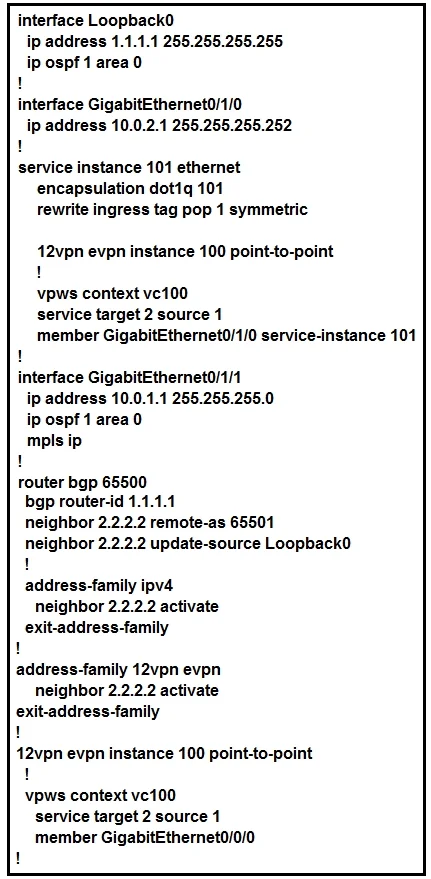
Refer to the exhibit. An engineer is trying to configure an EVPN VWPS. What is the issue with this configuration?
The correct answer is C. Interface GigabitEthernet0/1/0 should not have any IP address. In EVPN VPWS (Virtual Private Wire Service), the attachment circuit interface acts as a raw Layer 2 handoff - it extends an Ethernet "wire" between two PE routers. Assigning an IP address to GigabitEthernet0/1/0 converts it into a Layer 3 routed interface, which breaks the L2…
Question
Refer to the exhibit. An engineer is trying to configure an EVPN VWPS. What is the issue with this configuration?
Exhibit
Options
- AThe member in the VPWS context should be the PE-facing interface.
- BThe 12vpn evpn command should be instance 101.
- CInterface GigabitEthernet0/1/0 should not have any IP address.
- DThe service instance and the EVPN instance are different.
How the community answered
(30 responses)- A3% (1)
- B10% (3)
- C80% (24)
- D7% (2)
Explanation
In EVPN VPWS (Virtual Private Wire Service), the attachment circuit interface acts as a raw Layer 2 handoff - it extends an Ethernet "wire" between two PE routers. Assigning an IP address to GigabitEthernet0/1/0 converts it into a Layer 3 routed interface, which breaks the L2 forwarding behavior that VPWS depends on. The interface must be a pure L2 port (no IP) so that Ethernet frames are passed transparently across the EVPN pseudowire.
Why the distractors are wrong:
- A is incorrect because in a standard EVPN VPWS config, the VPWS context member correctly points to the service instance on the CE-facing (attachment circuit) interface - this part of the config is typically valid.
- B is incorrect because the
l2vpn evpninstance number is a locally significant identifier; there is no universal rule requiring it to be instance 101. - D is a common trap - the service instance ID and the EVPN instance ID do not have to match each other; they serve different purposes (one identifies the EFP, the other identifies the EVPN binding).
Memory tip: Think "VPWS = Wire = Layer 2 only." If you see an IP address on an attachment circuit interface in a VPWS question, that's always the red flag - wires don't have IP addresses.
Topics
Community Discussion
No community discussion yet for this question.