
300-515 · Question #144
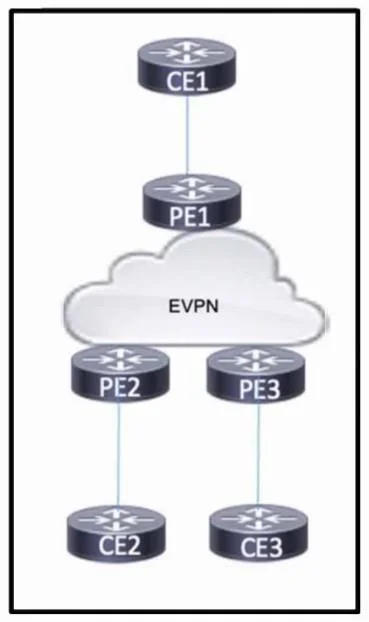
Refer to the exhibit. PE1 is located at a company's headquarters, with PE2 and PE3 at remote offices. A service provider implemented E-Tree for the company, with PE1 serving at the root and PE2 and…
The correct answer is D. Reconfigure PE3 as a root node. In an EVPN E-Tree, leaf nodes cannot communicate with other leaves-only with roots. With PE1 (root) down, PE2 (leaf) cannot reach services on PE3 (also leaf). Making PE3 a root node permits leaf-to-root forwarding and restores access when the PE1 link fails.
Question
Refer to the exhibit. PE1 is located at a company’s headquarters, with PE2 and PE3 at remote offices. A service provider implemented E-Tree for the company, with PE1 serving at the root and PE2 and PE3 serving as leaf nodes in the topology. For redundancy, PE3 offers some of the same services that that offered at headquarters. However, when the link to PE1 fails, users on PE2 cannot access the services on PE3. Which action must the engineer take to resolve the issue?
Exhibit
Options
- ASet the same MAC address for MLACP on each device.
- BChange the L2transport encapsulation type to MPLS.
- CAdd a secondary IP address to the interface facing the EVPN.
- DReconfigure PE3 as a root node.
How the community answered
(44 responses)- A11% (5)
- B5% (2)
- C25% (11)
- D59% (26)
Explanation
In an EVPN E-Tree, leaf nodes cannot communicate with other leaves-only with roots. With PE1 (root) down, PE2 (leaf) cannot reach services on PE3 (also leaf). Making PE3 a root node permits leaf-to-root forwarding and restores access when the PE1 link fails.
Topics
Community Discussion
No community discussion yet for this question.