
300-510 · Question #55
Refer to the exhibit. An engineer is addressing an IS-IS design issue which is running within the topology. All links are running on FastEthernet, except the link between R5 and R4, which is Gigabit…
The correct answer is B. All links have equal cost if the default metric is used. IS-IS, unlike OSPF, does not automatically derive interface cost from bandwidth. By default (using the narrow/default metric), IS-IS assigns a metric of 10 to all interfaces regardless of their speed or type. This means a FastEthernet link and a GigabitEthernet link both have…
Question
Refer to the exhibit. An engineer is addressing an IS-IS design issue which is running within the topology. All links are running on FastEthernet, except the link between R5 and R4, which is Gigabit Ethernet. Which statement about the design is true?
Exhibit
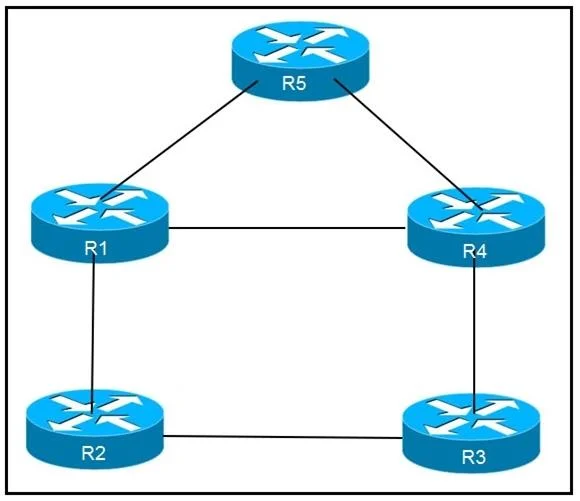
Options
- AR4 prefer to reach R5 using R1 as the next hop
- BAll links have equal cost if the default metric is used
- CR5 prefers to use R4 as the next hop for all routes
- DR1 prefer to use R5 as the next hop to reach R4
How the community answered
(23 responses)- A9% (2)
- B87% (20)
- C4% (1)
Explanation
IS-IS, unlike OSPF, does not automatically derive interface cost from bandwidth. By default (using the narrow/default metric), IS-IS assigns a metric of 10 to all interfaces regardless of their speed or type. This means a FastEthernet link and a GigabitEthernet link both have an IS-IS cost of 10 by default. As a result, all links in the topology have equal cost, and no link is preferred over another based on bandwidth alone - unless the administrator manually configures different metrics or enables the wide metric with interface-speed-based costing. Options A, C, and D describe preferences that would only exist if costs were unequal, which is not the case with default IS-IS metrics.
Topics
Community Discussion
No community discussion yet for this question.