
300-510 · Question #54
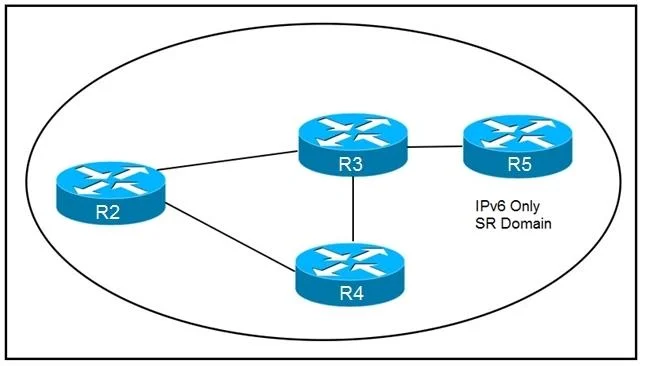
Refer to the exhibit. How are packets directed through the data plane when SRv6 is implemented?
The correct answer is A. An ordered list of segments is encoded in a routing extension header. SRv6 (Segment Routing over IPv6) directs packets through the data plane by encoding an ordered list of IPv6 Segment Identifiers (SIDs) inside an IPv6 Routing Extension Header, specifically the Segment Routing Header (SRH). Each SID represents an instruction (a segment) at a…
Question
Refer to the exhibit. How are packets directed through the data plane when SRv6 is implemented?
Exhibit
Options
- AAn ordered list of segments is encoded in a routing extension header
- BThe MPLS data plane is used to push labels onto IGP routes
- CA stack of labels represents an ordered list of segments
- DThe packet is encapsulated with a header and trailer encoding the ordered list of segments
How the community answered
(23 responses)- A91% (21)
- B4% (1)
- C4% (1)
Explanation
SRv6 (Segment Routing over IPv6) directs packets through the data plane by encoding an ordered list of IPv6 Segment Identifiers (SIDs) inside an IPv6 Routing Extension Header, specifically the Segment Routing Header (SRH). Each SID represents an instruction (a segment) at a node in the path. The active segment is the current IPv6 destination address, and as the packet traverses each node, the next SID is popped from the list and becomes the new destination. This is fundamentally different from SR-MPLS. Option B is wrong because MPLS is not used in SRv6. Option C describes SR-MPLS (label stack), not SRv6. Option D is wrong because SRv6 uses only an IPv6 header with extension headers - there is no trailer.
Topics
Community Discussion
No community discussion yet for this question.