
300-510 · Question #49
Refer to the exhibit. After troubleshooting an OSPF adjacency issue, routers 1, 2, and 3 have formed OSPF neighbor relationships. Which statement about the configuration is true?
The correct answer is C. Router 2 uses router 1 as the next hop for 192.168.0.0/24. Based on the exhibit context where routers 1, 2, and 3 have formed OSPF adjacencies, the correct statement is that Router 2 uses Router 1 as the next hop to reach 192.168.0.0/24. This is consistent with a topology where 192.168.0.0/24 is a network reachable through or behind…
Question
Refer to the exhibit. After troubleshooting an OSPF adjacency issue, routers 1, 2, and 3 have formed OSPF neighbor relationships. Which statement about the configuration is true?
Exhibit
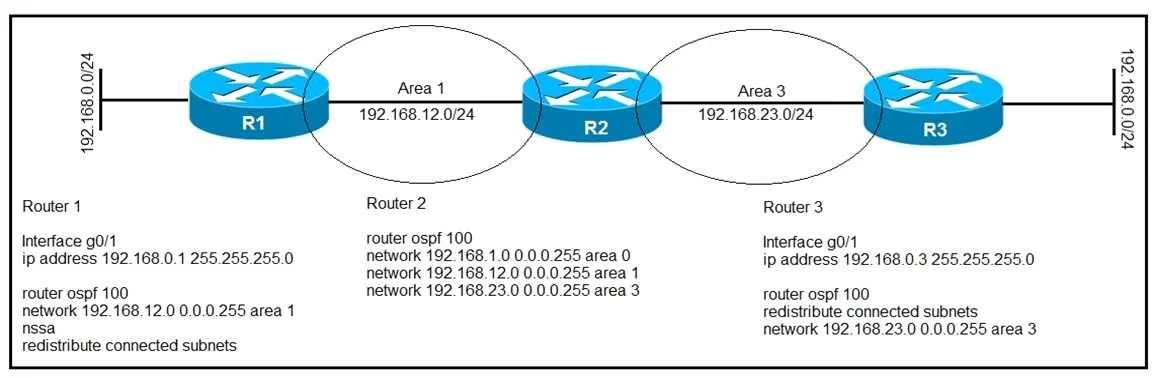
Options
- ARouter 2 receives a Type 5 LSAs from router 1 for its connected subnets
- BRouter 2 uses router 3 as the next hop for 192.168.0.0/24
- CRouter 2 uses router 1 as the next hop for 192.168.0.0/24
- DRouter 2 receives a Type 7 LSAs from router 3 for its connected subnets
How the community answered
(46 responses)- A7% (3)
- B17% (8)
- C74% (34)
- D2% (1)
Explanation
Based on the exhibit context where routers 1, 2, and 3 have formed OSPF adjacencies, the correct statement is that Router 2 uses Router 1 as the next hop to reach 192.168.0.0/24. This is consistent with a topology where 192.168.0.0/24 is a network reachable through or behind Router 1, and Router 2's SPF calculation selects Router 1 as the next hop. Type 5 LSAs (choice A) are generated by ASBRs for external routes, not for connected subnets in a standard OSPF area. Type 7 LSAs (choice D) are generated within NSSA areas, not standard areas. Choice B (using Router 3 as next hop) is inconsistent with the SPF result implied by the topology in the exhibit.
Topics
Community Discussion
No community discussion yet for this question.