
300-510 · Question #37
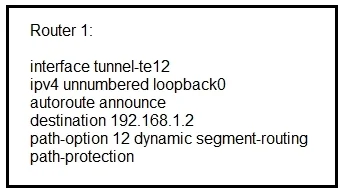
Refer to the exhibit. Router 1 has established an SR-TE tunnel with router 2. Which statement describes this configuration?
The correct answer is C. Router 1 is the head-end tunnel and has dynamically chosen a path to router 2. In SR-TE, the head-end router is the one that originates and controls the tunnel. Router 1 is the head-end because it initiates the SR-TE policy toward Router 2 (the tail-end). The exhibit shows a dynamic path, meaning Router 1 used a PCE or its own path computation algorithm…
Question
Refer to the exhibit. Router 1 has established an SR-TE tunnel with router 2. Which statement describes this configuration?
Exhibit
Options
- ARouter 1 has a list of labels used to explicitly lay out a path to router 2.
- BRouter 1 and router 2 have a bidirectional tunnel set up with dynamic path selection.
- CRouter 1 is the head-end tunnel and has dynamically chosen a path to router 2.
- DRouter 2 is the head-end tunnel and has explicitly set a path to router 1.
How the community answered
(26 responses)- A8% (2)
- B4% (1)
- C85% (22)
- D4% (1)
Explanation
In SR-TE, the head-end router is the one that originates and controls the tunnel. Router 1 is the head-end because it initiates the SR-TE policy toward Router 2 (the tail-end). The exhibit shows a dynamic path, meaning Router 1 used a PCE or its own path computation algorithm (e.g., using SR-PCE or CSPF) to automatically calculate the best path rather than using a manually defined explicit segment list. Option A describes explicit path configuration (a static label stack), not dynamic. Option B is incorrect because SR-TE tunnels are unidirectional by default. Option D is incorrect because the tail-end (Router 2) does not originate the tunnel.
Topics
Community Discussion
No community discussion yet for this question.