
300-510 · Question #300
Refer to the exhibit. An enterprise is running OSPF within its network. Cisco Express Forwarding is enabled on all connected links between routers. Users on the network report that they cannot reach…
The correct answer is D. Enable LDP on the link between R1 and R4. In an MPLS network, CEF provides the underlying IP forwarding mechanism, but it does not distribute labels by itself. Label Distribution Protocol (LDP) is what enables neighboring routers to exchange and negotiate MPLS labels for prefixes. If LDP is not enabled on the physical…
Question
Refer to the exhibit. An enterprise is running OSPF within its network. Cisco Express Forwarding is enabled on all connected links between routers. Users on the network report that they cannot reach application servers connected to R1. While troubleshooting the problem, a network engineer checked the MPLS forwarding table and noticed that labels are missing for the link between R1 and R4. Which action must the engineer take to resolve the issue?
Exhibit
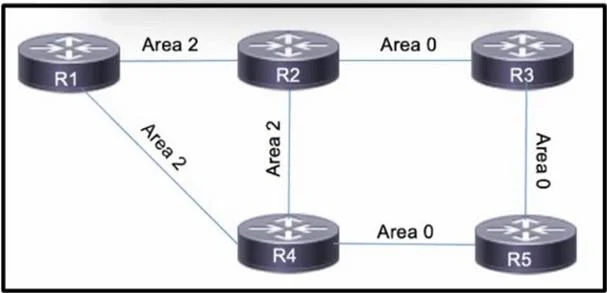
Options
- AConfigure the OSPF router ID on R1 and R4 as a loopback interface with a /32 mask.
- BPlace the R1-R2 and R1-R4 links into area 0.
- CImplement a virtual link from R1 to either R2 or R4 so that R1 can connect to area 0.
- DEnable LDP on the link between R1 and R4.
How the community answered
(52 responses)- A6% (3)
- B2% (1)
- C10% (5)
- D83% (43)
Explanation
In an MPLS network, CEF provides the underlying IP forwarding mechanism, but it does not distribute labels by itself. Label Distribution Protocol (LDP) is what enables neighboring routers to exchange and negotiate MPLS labels for prefixes. If LDP is not enabled on the physical link between R1 and R4, those two routers cannot establish an LDP session over that link, so no labels will be advertised or installed for that segment - exactly the symptom described (missing labels in the MPLS forwarding table for that link). Enabling LDP on both R1 and R4's interconnecting interfaces establishes the LDP adjacency and populates the missing label entries, restoring end-to-end MPLS forwarding to the application servers on R1.
Topics
Community Discussion
No community discussion yet for this question.