
300-510 · Question #298
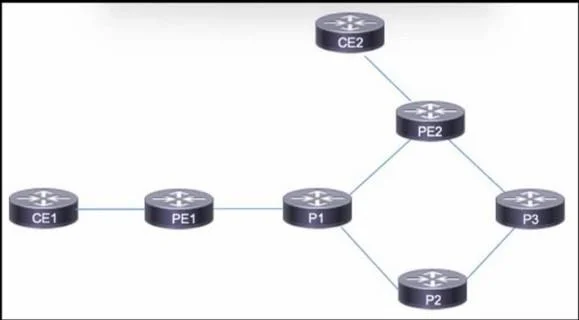
Refer to the exhibit. A regional service provider provides connectivity for a growing enterprise, which recently acquired a new location in a nearby city. The new location, which is connected at…
The correct answer is C. Implement SR within the service provider network using IS-IS only. Before you can steer traffic via SR-TE, you must turn on segment-routing in your IGP so that each router advertises its Prefix-SIDs and Adjacency-SIDs. In Cisco IOS-XR (and many SP deployments) this is only supported under IS-IS, so the very first step is to enable MPLS-based…
Question
Refer to the exhibit. A regional service provider provides connectivity for a growing enterprise, which recently acquired a new location in a nearby city. The new location, which is connected at CE2. requires connectivity to the company's data center, which is connected to CE1. The service provider will use VPNv4 to connect the two locations. The networking team is planning to implement segment-routing traffic engineering to route traffic from PE1 to PE2 over a delay- optimized path through P2. Which action must the engineering team take to begin the implementation?
Exhibit
Options
- AImplement a GRE tunnel between PE1 and PE2
- BImplement BGP peering between PE1 and P2 using IPv4.
- CImplement SR within the service provider network using IS-IS only.
- DImplement a BGP extended community for routes between CE1 and CE2.
How the community answered
(45 responses)- A4% (2)
- B18% (8)
- C71% (32)
- D7% (3)
Explanation
Before you can steer traffic via SR-TE, you must turn on segment-routing in your IGP so that each router advertises its Prefix-SIDs and Adjacency-SIDs. In Cisco IOS-XR (and many SP deployments) this is only supported under IS-IS, so the very first step is to enable MPLS-based segment-routing within your IS-IS domain. Once your underlay is carrying SR labels, you can build the explicit SR-TE path through P2.
Topics
Community Discussion
No community discussion yet for this question.