
300-510 · Question #282
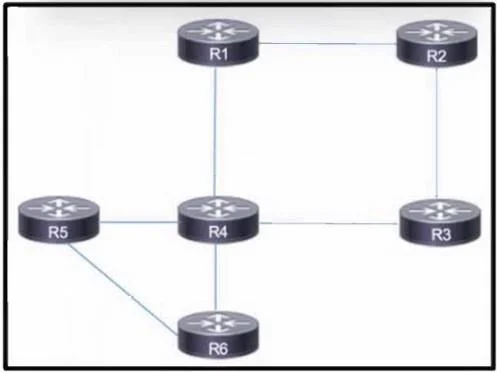
Refer to the exhibit. Early in the growth cycle of a small enterprise the network-engineering team implemented segment routing to support automation of the IPv4 network. As the network grew…
The correct answer is A. Implement the flexible algorithm to customize the shortest path through the network. SRv6 Flexible Algorithm (Flex-Algo) is the correct tool for path customization within a Segment Routing network. Flex-Algo allows network operators to define custom shortest-path computation algorithms using specific metrics (e.g., latency, TE metric), link affinities…
Question
Refer to the exhibit. Early in the growth cycle of a small enterprise the network-engineering team implemented segment routing to support automation of the IPv4 network. As the network grew organically more devices were added and the company migrated to SRv6. The company is now planning to significantly expand the number of hosts connected to R2 and R6 which will require further path manipulation. Which action must the team take to customize the route that traffic takes between endpoints in the network?
Exhibit
Options
- AImplement the flexible algorithm to customize the shortest path through the network
- BImplement MLAG to reduce traffic load on heavily congested links
- CImplement spanning-tree protocol to avoid loops between excess devices in the network
- DImplement priority queuing to drop non-mission-critical traffic.
How the community answered
(36 responses)- A78% (28)
- B3% (1)
- C6% (2)
- D14% (5)
Explanation
SRv6 Flexible Algorithm (Flex-Algo) is the correct tool for path customization within a Segment Routing network. Flex-Algo allows network operators to define custom shortest-path computation algorithms using specific metrics (e.g., latency, TE metric), link affinities (include/exclude certain links), or algorithmic constraints. This enables fine-grained traffic engineering without requiring RSVP-TE, making it ideal for the described expansion scenario where specific paths must be preferred. MLAG (Multi-Chassis Link Aggregation) is a Layer 2 redundancy protocol and does not manipulate routing paths. Spanning Tree Protocol (STP) is a Layer 2 loop-prevention mechanism with no role in IPv6 routing. Priority queuing is a QoS mechanism that affects traffic treatment within a queue, not the actual path the traffic takes through the network.
Topics
Community Discussion
No community discussion yet for this question.