
300-510 · Question #281
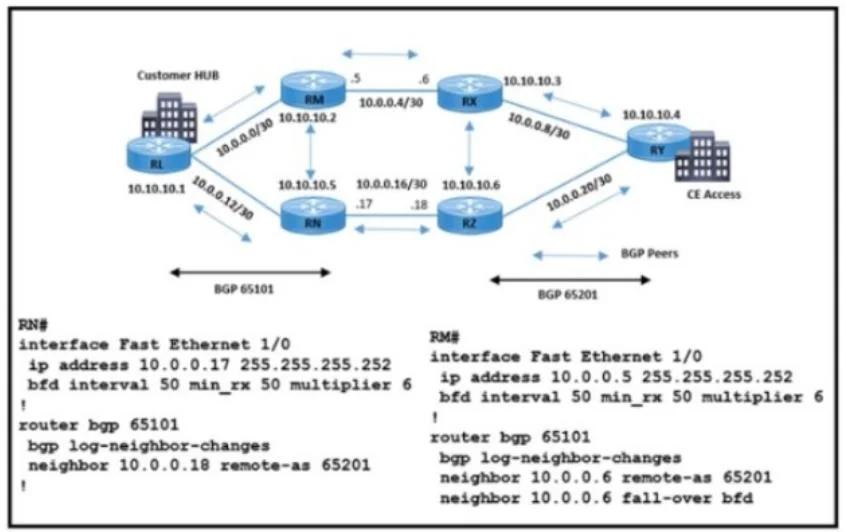
Refer to the exhibit. EBGP peering is up between BGP AS 65101 and BGP AS 65201. The service provider expects traffic convergence within 300ms between the two autonomous systems but the network…
The correct answer is A. Change the bfd multiplier value to 3 on routers RN and RM E. Change the bfd interval value to 100ms on routers RN and RM. BFD (Bidirectional Forwarding Detection) detects link or path failures in sub-second time. The BFD failure detection time is calculated as: TX_interval × Multiplier. To achieve convergence within 300ms, the BFD timers must be tuned so that (interval × multiplier) ≤ 300ms…
Question
Refer to the exhibit. EBGP peering is up between BGP AS 65101 and BGP AS 65201. The service provider expects traffic convergence within 300ms between the two autonomous systems but the network operations team sees that route and traffic convergence is too slow. Which two actions improve the convergence time? (Choose two.)
Exhibit
Options
- AChange the bfd multiplier value to 3 on routers RN and RM
- BConfigure fall-over bfd under the BGP instance for BGP neighbors on RN
- CConfigure bfd interval 50 min_rx 100 multiplier 6 on the connected interfaces on RN and RM
- DConfigure bfd interval 50 min_rx 50 multiplier 6 on the connected interfaces on RL and RY
- EChange the bfd interval value to 100ms on routers RN and RM
How the community answered
(39 responses)- A79% (31)
- B5% (2)
- C13% (5)
- D3% (1)
Explanation
BFD (Bidirectional Forwarding Detection) detects link or path failures in sub-second time. The BFD failure detection time is calculated as: TX_interval × Multiplier. To achieve convergence within 300ms, the BFD timers must be tuned so that (interval × multiplier) ≤ 300ms. Option E sets the BFD interval to 100ms, and Option A sets the multiplier to 3, yielding a detection time of 100ms × 3 = 300ms - exactly meeting the requirement. These two changes together achieve the target. Option B ('fall-over bfd') is a BGP-level command that links BFD failure detection to BGP neighbor takedown, but it does not tune the BFD timers themselves, so it would not fix the slow convergence. Option C configures BFD with min_rx 100ms and multiplier 6, giving 100 × 6 = 600ms detection - too slow. Option D targets routers RL and RY (not RN and RM where the EBGP peering exists) and would not affect the peering between the correct routers.
Topics
Community Discussion
No community discussion yet for this question.