
300-510 · Question #223
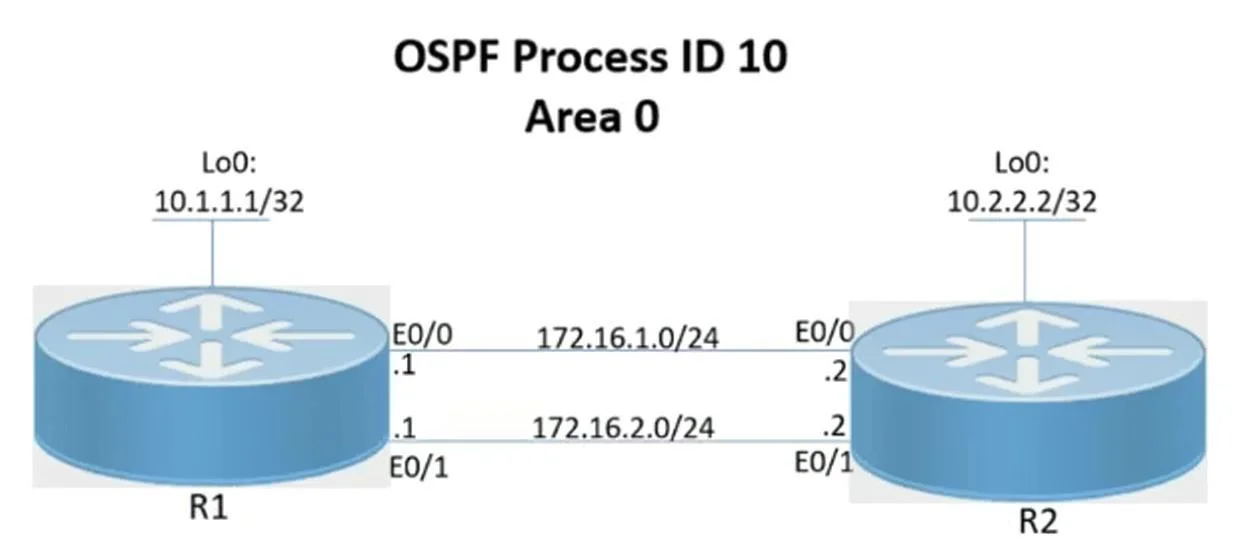
SIMULATION Guidelines This is a lab item in which tasks will be performed on virtual devices. - Refer to the Tasks tab to view the tasks for this lab item. - Refer to the Topology tab to access the…
The correct answer is C. P1(config-isis-if-af)# prefix-sid index 10 PE2(config)# segment-routing local-block 15000 15999 P2(config-isis-if-af)# prefix-sid index 50. There is a notable structural issue with this question worth flagging before the explanation: the simulation task describes OSPF configuration (point-to-point interfaces, cost, hello/dead timers), but all four answer choices are IS-IS Segment Routing commands (prefix-sid…
Question
Exhibit
Options
- AP1(config-isis-if-af)# prefix-sid index 15010 PE2(config)# segment-routing local-block 16000 16999 PE2(config-isis-if-af)# prefix-sid index 16050
- BP1(config-isis-if-af)# adjacency-sid index 15010 PE2(config)# segment-routing local-block 50000 50099 PE2(config-isis-if-af)# adjacency-sid index 50050
- CP1(config-isis-if-af)# prefix-sid index 10 PE2(config)# segment-routing local-block 15000 15999 P2(config-isis-if-af)# prefix-sid index 50
- DPE1(config-isis-if-af)# adjacency-sid index 10 P2(config)# segment-routing local-block 30000 30999 P2(config-isis-if-af)# adjacency-sid index 50
How the community answered
(14 responses)- A7% (1)
- B7% (1)
- C71% (10)
- D14% (2)
Explanation
There is a notable structural issue with this question worth flagging before the explanation: the simulation task describes OSPF configuration (point-to-point interfaces, cost, hello/dead timers), but all four answer choices are IS-IS Segment Routing commands (prefix-sid, adjacency-sid, SRGB/SRLB). These appear to be from two different questions that were accidentally merged.
That said, evaluating the choices purely on IS-IS Segment Routing merit:
Why C is correct: Option C correctly uses prefix-sid index to assign globally significant node SIDs to prefixes, which is the proper mechanism for SR-MPLS reachability in IS-IS. The local-block range 15000 15999 is a valid SRLB configuration, and the small index values (10 and 50) are valid.
Why the others are wrong:
- A assigns
prefix-sid index 15010to P1, but the SRGB defined on PE2 starts at16000, meaning index 15010 falls outside the global block - a misconfiguration that breaks SR label allocation. - B uses
adjacency-sid index, which creates locally significant link SIDs, not globally routable node/prefix SIDs. This is the wrong SID type for end-to-end SR paths. - D also uses
adjacency-sidon PE1 and P2 - same fundamental error as B; adjacency SIDs cannot substitute for prefix SIDs in SR forwarding.
Memory tip: "Prefix SID = global reachability; Adjacency SID = local link." Whenever a question involves routing traffic to a node end-to-end via SR, prefix-sid is correct. adjacency-sid only matters for explicit link-level steering (SR-TE with specific hop pinning).
Note for your exam prep: If you see this question on the actual exam, verify whether the simulation task and the answer choices are genuinely about OSPF or SR/IS-IS - they may appear on separate items.
Topics
Community Discussion
No community discussion yet for this question.