
300-510 · Question #222
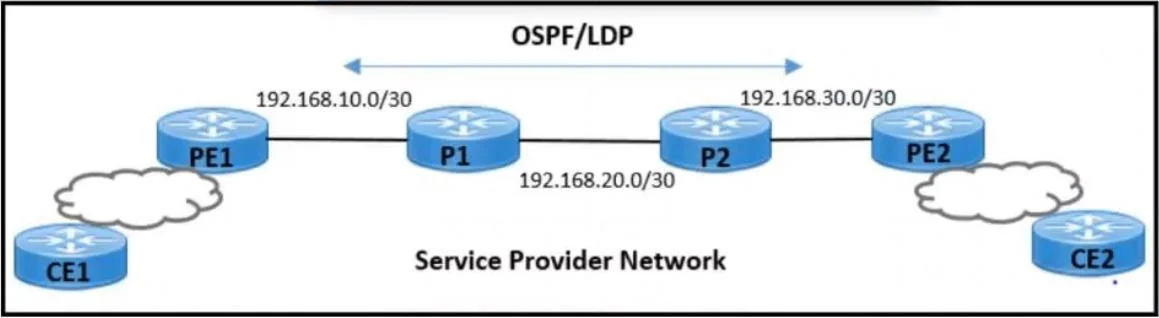
Refer to the exhibit. A network engineer is enabling a segment routing solution with these requirements: - A service provider is using the default and nondefault SID range for interface allocation…
The correct answer is C. PE1(config-isis-if-af)# prefix-sid index 10 PE2(config)# segment-routing local-block 15000 15999 PE2(config-isis-if-af)# prefix-sid index 50. Option C is correct because it uses prefix-sid - the appropriate command for assigning Segment IDs to interface prefixes/routes - and configures a proper nondefault local block (15000 15999) that does not overlap with the default SRGB (typically starting at 16000+). The index…
Question
Refer to the exhibit. A network engineer is enabling a segment routing solution with these requirements:
- A service provider is using the default and nondefault SID range for
interface allocation.
- 192.168.10.0/30 interface should add an index value of 20 SID from
the default range.
- 192.168.30.0/30 interface should use a nondefault range and index
value of 50. Which configuration must be implemented to meet the requirements? A. B. C. D.
Exhibits

Options
- APE1(config-isis-if-af)# prefix-sid index 15010 PE2(config)# segment-routing local-block 16000 16999 PE2(config-isis-if-af)# prefix-sid index 16050
- BP1(config-isis-if-af)# adjacency-sid index 15010 PE2(config)# segment-routing local-block 50000 50999 PE2(config-isis-if-af)# adjacency-sid index 50050
- CPE1(config-isis-if-af)# prefix-sid index 10 PE2(config)# segment-routing local-block 15000 15999 PE2(config-isis-if-af)# prefix-sid index 50
- DPE1(config-isis-if-af)# adjacency-sid index 10 PE2(config)# segment-routing local-block 30000 30999 PE2(config-isis-if-af)# adjacency-sid index 50
How the community answered
(35 responses)- A6% (2)
- B9% (3)
- C71% (25)
- D14% (5)
Explanation
Option C is correct because it uses prefix-sid - the appropriate command for assigning Segment IDs to interface prefixes/routes - and configures a proper nondefault local block (15000 15999) that does not overlap with the default SRGB (typically starting at 16000+). The index values (10 and 50) are correctly specified as small offset integers relative to each block's base address, and segment-routing local-block is the correct IOS XR syntax for defining a nondefault SID range.
Options B and D are wrong for the same fundamental reason: they use adjacency-sid instead of prefix-sid. Adjacency SIDs identify specific links between neighbors for traffic steering; they are not used for prefix/interface allocation as required here.
Option A is wrong because the index values (15010, 16050) are abnormally large - they read as absolute SID labels, not index offsets from a block base. Additionally, declaring a local-block of 16000 16999 conflicts with the default SRGB, which typically begins at 16000.
Memory tip: Think "P for P" - Prefix-SID goes with Prefixes. Whenever a question mentions interface or route-based SID allocation, prefix-sid is your command; adjacency-sid only applies to link-specific forwarding between adjacent routers.
Topics
Community Discussion
No community discussion yet for this question.