
300-510 · Question #216
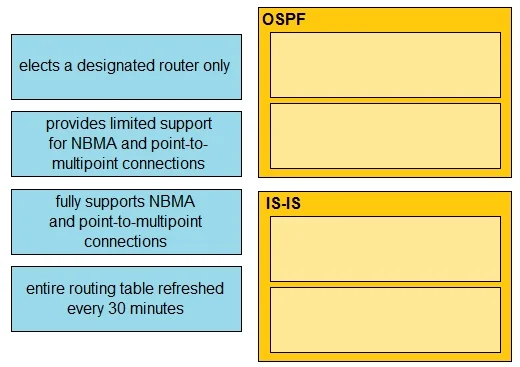
Drag and Drop Question Drag and drop the features from the left onto the corresponding routing protocols on the right. Answer:
This question tests the understanding of key characteristics differentiating OSPF and IS-IS, specifically concerning designated router election, support for various network types like NBMA and point-to-multipoint, and link-state database refresh mechanisms.
Question
Drag and Drop Question Drag and drop the features from the left onto the corresponding routing protocols on the right. Answer:
Exhibit
Explanation
This question tests the understanding of key characteristics differentiating OSPF and IS-IS, specifically concerning designated router election, support for various network types like NBMA and point-to-multipoint, and link-state database refresh mechanisms.
Approach. The correct interaction is to drag the feature descriptions from the left to their corresponding routing protocols on the right, as shown in the second exhibit image:
For OSPF:
- 'fully supports NBMA and point-to-multipoint connections': OSPF provides specific network types (e.g., Non-Broadcast Multi-Access, Point-to-Multipoint) which, when configured correctly, offer comprehensive and explicit support for these complex topologies.
- 'entire routing table refreshed every 30 minutes': While link-state protocols do not refresh the 'entire routing table' like distance-vector protocols, OSPF's Link State Advertisements (LSAs) have an age timer and are periodically refreshed or reflooded (typically every 30 minutes or 1800 seconds) to maintain database synchronization. This statement refers to the periodic refresh of the link-state database elements from which the routing table is derived.
For IS-IS:
- 'elects a designated router only': On broadcast multi-access networks, IS-IS elects a Designated Intermediate System (DIS) to handle multicast traffic and synchronize the link-state database. Unlike OSPF, which elects both a Designated Router (DR) and a Backup Designated Router (BDR), IS-IS does not elect a backup, hence it 'elects a designated router only'.
- 'provides limited support for NBMA and point-to-multipoint connections': While IS-IS is highly adaptable to various topologies, its native adjacency formation, based on CLNS, may require more specific considerations or be perceived as less straightforward for IP routing over certain NBMA/P2MP setups compared to OSPF's dedicated and explicit IP network types. This can be interpreted as 'limited' in comparison to OSPF's explicit mechanisms for IP over these media.
Common mistakes.
- common_mistake. Common mistakes include confusing the designated router election process-OSPF elects both a DR and BDR, while IS-IS elects only a DIS. Another frequent error is incorrectly attributing 'fully supports NBMA' or 'limited support for NBMA' to the wrong protocol, as both protocols can function in these environments, and the distinction between 'fully' and 'limited' can be subtle and context-dependent. Misinterpreting 'entire routing table refreshed every 30 minutes' is also common; this refers to the periodic refresh of link-state database entries (LSAs for OSPF) rather than a full routing table update in the manner of a distance-vector protocol, and this specific time frame is a characteristic of OSPF's LSA refresh.
Concept tested. Core differences and operational characteristics of OSPF (Open Shortest Path First) and IS-IS (Intermediate System to Intermediate System) routing protocols, specifically focusing on their designated router election processes, methods for handling various network topologies (such as NBMA and point-to-multipoint), and link-state database maintenance mechanisms.
Topics
Community Discussion
No community discussion yet for this question.