
300-510 · Question #215
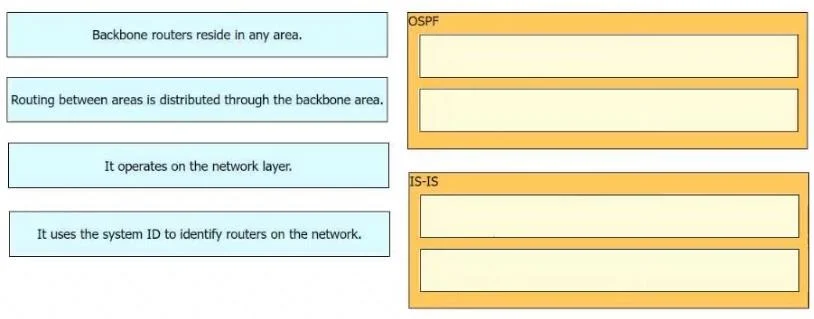
Drag and Drop Question Drag and drop the characteristics from the left onto the corresponding routing protocols on the right. Answer:
The correct answer is Routing between areas is distributed through the backbone area.; It operates on the network layer.; Backbone routers reside in any area.; It uses the system ID to identify routers on the network. This question tests the candidate's knowledge of the distinguishing characteristics of OSPF and IS-IS, two prominent link-state routing protocols, focusing on their operational mechanisms and architectural differences.
Question
Drag and Drop Question Drag and drop the characteristics from the left onto the corresponding routing protocols on the right. Answer:
Exhibit
Answer Area
Drag items
Correct arrangement
- Routing between areas is distributed through the backbone area.
- It operates on the network layer.
- Backbone routers reside in any area.
- It uses the system ID to identify routers on the network.
Explanation
This question tests the candidate's knowledge of the distinguishing characteristics of OSPF and IS-IS, two prominent link-state routing protocols, focusing on their operational mechanisms and architectural differences.
Approach. The correct approach is to drag the characteristics to their respective routing protocols as shown in the solution image. Here's the reasoning for each placement:
For OSPF:
- 'Routing between areas is distributed through the backbone area.' This characteristic specifically describes OSPF's hierarchical design, where Area 0 (the backbone area) is central and mandatory for all inter-area traffic. All non-backbone areas must connect to Area 0, and inter-area routing always traverses the backbone.
- 'It operates on the network layer.' OSPF encapsulates its protocol messages directly into IP packets (using IP protocol number 89), meaning it operates directly on the network (IP) layer.
For IS-IS:
- 'Backbone routers reside in any area.' IS-IS uses a two-level hierarchy (Level 1 for intra-area, Level 2 for inter-area/backbone routing), but unlike OSPF, its Level 2 (backbone) routers are not confined to a single, distinct 'backbone area' like OSPF's Area 0. Level 2 routers can exist in any IS-IS area.
- 'It uses the system ID to identify routers on the network.' IS-IS identifies routers using a unique System ID, which is a 6-byte identifier part of the Network Entity Title (NET). OSPF, in contrast, uses a Router ID, which is a 32-bit value typically configured as an IP address.
Common mistakes.
- common_mistake. A common mistake would be confusing the hierarchical models or the identification mechanisms of OSPF and IS-IS. For example, incorrectly associating 'Backbone routers reside in any area' with OSPF, which strictly uses Area 0 as its backbone, would be wrong. Similarly, assigning 'It uses the system ID to identify routers' to OSPF instead of IS-IS, which uses System IDs as part of its NETs, would be incorrect. Another potential error is misunderstanding the layer of operation; while both are Layer 3 routing protocols, OSPF directly uses IP (Layer 3) for its control plane, whereas IS-IS operates directly over the data link layer (Layer 2) for its protocol messages, making the 'operates on the network layer' statement more distinctively applicable to OSPF's encapsulation method in this context.
Concept tested. Link-State Routing Protocols, OSPF (Open Shortest Path First) characteristics, IS-IS (Intermediate System to Intermediate System) characteristics, Network Layer operation, hierarchical routing models, router identification mechanisms.
Topics
Community Discussion
No community discussion yet for this question.