
300-510 · Question #119
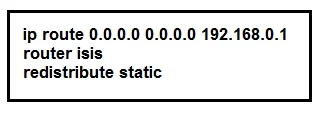
Refer to the exhibit. An administrator is troubleshooting Internet access issues on a customer's network. After applying this ISIS configuration to R1, the administrator notices that it fails to…
The correct answer is B. Add the default-information originate command to the configuration. Option B is correct because IS-IS does not automatically redistribute a default route into the domain just because one exists in the routing table. The default-information originate command must be explicitly added under the IS-IS process to instruct the router to generate and…
Question
Refer to the exhibit. An administrator is troubleshooting Internet access issues on a customer's network. After applying this ISIS configuration to R1, the administrator notices that it fails to redistribute the default route into IS-IS. After checking the connectivity between the ISIS router and the ISP router the engineer confirmed there is Layer 3 connectivity between them. Which action should be taken to correct the problem?
Exhibit
Options
- AAssociate the default route with a VRF
- BAdd the default-information originate command to the configuration
- CConfigure the default route under any routing protocol other than IS-IS
- DConfigure R1 as a Layer 1 router
How the community answered
(49 responses)- A4% (2)
- B76% (37)
- C12% (6)
- D8% (4)
Explanation
Option B is correct because IS-IS does not automatically redistribute a default route into the domain just because one exists in the routing table. The default-information originate command must be explicitly added under the IS-IS process to instruct the router to generate and advertise a default route (0.0.0.0/0) to other IS-IS neighbors - without it, the default route is silently ignored during redistribution regardless of connectivity.
Option A is wrong because VRFs are used for network segmentation/MPLS VPN scenarios and have no bearing on whether a default route gets redistributed into IS-IS on the global routing table.
Option C is wrong because redistributing the default route under a different protocol (e.g., OSPF or EIGRP) still wouldn't inject it into IS-IS - other IS-IS routers need to receive it via IS-IS, not via a separate protocol.
Option D is wrong because Level 1 routers in IS-IS are intra-area only and actually have less capability to handle external/inter-area routing; making R1 Level 1-only would worsen the problem, not fix it.
Memory tip: Treat IS-IS like OSPF - both require default-information originate to push a default route into the protocol. If you remember it for OSPF, remember it works the same way in IS-IS: the router won't "share what it hasn't been told to originate."
Topics
Community Discussion
No community discussion yet for this question.