
300-510 · Question #118
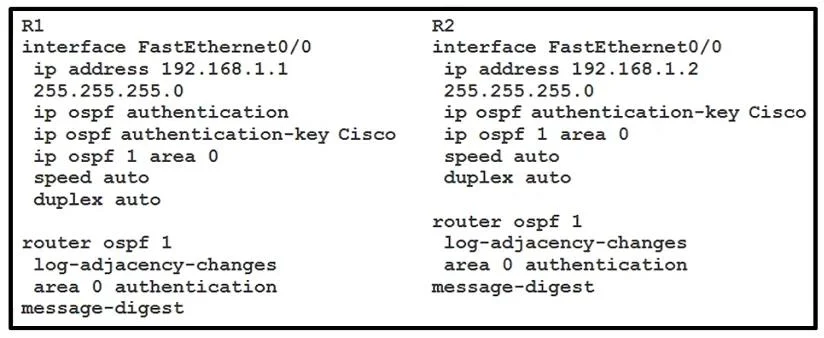
Refer io the exhibit. While applying the configurations on two routers an engineer notices that OSPF adjacency Between them remains down. Through the ping test the engineer confirmed that both me…
The correct answer is A. Enter the command ip ospf authentication in R2 interface. Option A is correct because the exhibit shows R1 using area-level plain-text authentication (area 0 authentication) while R2 has area-level MD5 authentication (area 0 authentication message-digest) configured on its OSPF process. Adding ip ospf authentication directly on R2's…
Question
Refer io the exhibit. While applying the configurations on two routers an engineer notices that OSPF adjacency Between them remains down. Through the ping test the engineer confirmed that both me routers have Layer 3 reachability between them. Which action should me engineer take to make the adjacencies to full?
Exhibit
Options
- AEnter the command ip ospf authentication in R2 interface
- BEnable OSPF just inside the router OSPF process not in the interfaces of any router
- CDelete the area 0 authentication message-digest command from the OSPF process in R1
- DDelete the area 0 authentication message-digest command from the OSPF process in R2
How the community answered
(28 responses)- A75% (21)
- B7% (2)
- C14% (4)
- D4% (1)
Explanation
Option A is correct because the exhibit shows R1 using area-level plain-text authentication (area 0 authentication) while R2 has area-level MD5 authentication (area 0 authentication message-digest) configured on its OSPF process. Adding ip ospf authentication directly on R2's interface overrides the area-level MD5 setting, forcing R2 to use plain-text authentication - matching R1 and allowing the adjacency to reach Full state.
Option B is wrong because OSPF is already running on both routers (Layer 3 reachability is confirmed), and removing interface-level OSPF configuration would break adjacency further rather than fix it - this doesn't address the authentication mismatch.
Option C is wrong because R1 is configured with area 0 authentication (plain-text), not area 0 authentication message-digest, so that command does not exist on R1 and cannot be deleted.
Option D is wrong because deleting area 0 authentication message-digest from R2 would leave R2 with no authentication, which still mismatches R1's plain-text authentication requirement - adjacency would remain down.
Memory tip: Think "interface beats area" - interface-level OSPF authentication always overrides area-level authentication. Whenever you see OSPF adjacency failing despite confirmed Layer 3 reachability, immediately suspect an authentication type mismatch between routers.
Topics
Community Discussion
No community discussion yet for this question.