
300-510 · Question #10
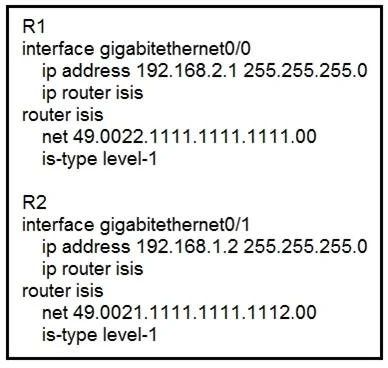
Refer to the exhibit. Routers R1 and R2 cannot form a neighbor relationship, but the network is otherwise configured correctly and operating normally. Which two statements describe the problem?…
The correct answer is B. The two routers are in different subnets E. The two routers are in different areas. Two conditions are required for OSPF neighbors to form an adjacency: they must share the same subnet (their IP addresses must be in the same network), and they must belong to the same OSPF area. From the exhibit, R1 and R2 have IP addresses on different subnets (B), meaning…
Question
Refer to the exhibit. Routers R1 and R2 cannot form a neighbor relationship, but the network is otherwise configured correctly and operating normally. Which two statements describe the problem? (Choose two.)
Exhibit
Options
- AThe two routers are in the same area
- BThe two routers are in different subnets
- CThe two routers have password mismatch issues
- DThe two routers have the same network ID
- EThe two routers are in different areas
How the community answered
(62 responses)- A5% (3)
- B90% (56)
- C2% (1)
- D3% (2)
Explanation
Two conditions are required for OSPF neighbors to form an adjacency: they must share the same subnet (their IP addresses must be in the same network), and they must belong to the same OSPF area. From the exhibit, R1 and R2 have IP addresses on different subnets (B), meaning their hello packets cannot reach each other at Layer 3 as expected peers, and they are configured in different areas (E), which independently would also prevent adjacency. Different subnets cause the neighbor to be unreachable, and different areas cause OSPF to reject the hello packets.
Topics
Community Discussion
No community discussion yet for this question.