
300-420 · Question #39
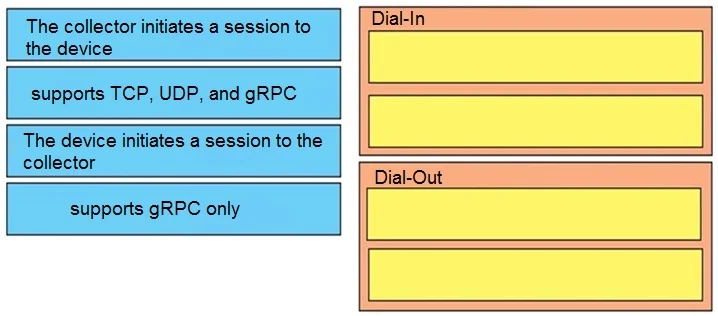
Drag and Drop Question Drag and drop the characteristics from the left onto the correct telemetry mode on the right. Answer:
The correct answer is The collector initiates a session to the device; supports gRPC only; The device initiates a session to the collector; supports TCP, UDP, and gRPC. This question tests the understanding of two primary telemetry modes, Dial-In and Dial-Out, by requiring the test-taker to associate their correct characteristics regarding session initiation and supported protocols.
Question
Exhibit
Answer Area
Drag items
Correct arrangement
- The collector initiates a session to the device
- supports gRPC only
- The device initiates a session to the collector
- supports TCP, UDP, and gRPC
Explanation
This question tests the understanding of two primary telemetry modes, Dial-In and Dial-Out, by requiring the test-taker to associate their correct characteristics regarding session initiation and supported protocols.
Approach. The correct interaction involves dragging each characteristic to its appropriate telemetry mode based on its definition:
- 'The collector initiates a session to the device' is dragged to the 'Dial-In' category. In Dial-In mode, the data collector actively connects to the networking device to pull telemetry data.
- 'supports gRPC only' is dragged to the 'Dial-In' category. While Dial-In can technically support other protocols in some contexts, in modern streaming telemetry, particularly for high-performance and structured data, gRPC is the predominant and often exclusive protocol used by collectors to 'dial-in' and retrieve data.
- 'The device initiates a session to the collector' is dragged to the 'Dial-Out' category. In Dial-Out mode, the networking device actively pushes telemetry data to the collector, initiating the connection itself.
- 'supports TCP, UDP, and gRPC' is dragged to the 'Dial-Out' category. Dial-Out telemetry, which includes older methods like NetFlow/IPFIX (UDP), syslog (TCP), and newer streaming methods (gRPC), can leverage a broader range of transport protocols because the device is responsible for pushing the data.
Common mistakes.
- common_mistake. A common mistake would be to confuse which entity initiates the connection. For instance, incorrectly dragging 'The collector initiates a session to the device' to 'Dial-Out' or 'The device initiates a session to the collector' to 'Dial-In'. Another error could be misassociating the protocols; assuming 'supports gRPC only' applies to Dial-Out, or that 'supports TCP, UDP, and gRPC' applies to Dial-In. This indicates a misunderstanding of the typical transport mechanisms and initiation patterns for each telemetry mode.
Concept tested. Network telemetry modes: Dial-In versus Dial-Out, including session initiation responsibility and supported transport protocols (TCP, UDP, gRPC) for streaming telemetry data.
Topics
Community Discussion
No community discussion yet for this question.