
300-420 · Question #40
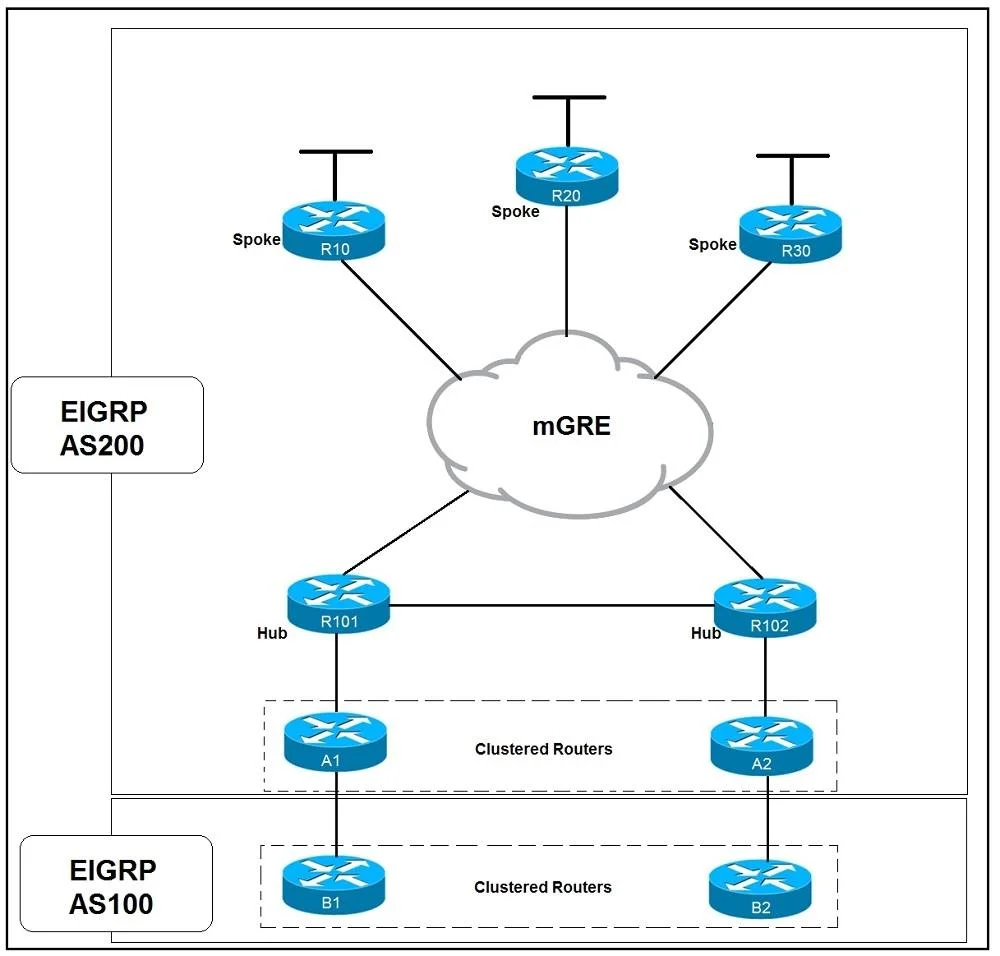
Refer to the exhibit. Which solution decreases the EIGRP convergence time?
The correct answer is D. Enable stub routing on the spokes. In a hub-and-spoke topology, EIGRP convergence is slowed by query propagation. When a route goes down, the hub sends EIGRP queries to all spoke routers and must wait for replies from every one before declaring the route unreachable - this is known as the 'Stuck in Active' (SIA)…
Question
Refer to the exhibit. Which solution decreases the EIGRP convergence time?
Exhibit
Options
- AEnable subsecond timers
- BIncrease the hold time value
- CIncrease the dead timer value
- DEnable stub routing on the spokes
How the community answered
(35 responses)- B3% (1)
- C9% (3)
- D89% (31)
Explanation
In a hub-and-spoke topology, EIGRP convergence is slowed by query propagation. When a route goes down, the hub sends EIGRP queries to all spoke routers and must wait for replies from every one before declaring the route unreachable - this is known as the 'Stuck in Active' (SIA) problem. Enabling stub routing on spoke routers tells the hub that spokes only have locally connected or summarized routes, so the hub excludes them from the query process entirely. This dramatically reduces the convergence time because the query domain is bounded at the hub. Option A (subsecond timers) reduces detection time but not the query explosion problem. Options B and C (increasing hold/dead timers) would actually slow convergence by delaying failure detection.
Topics
Community Discussion
No community discussion yet for this question.