
300-420 · Question #152
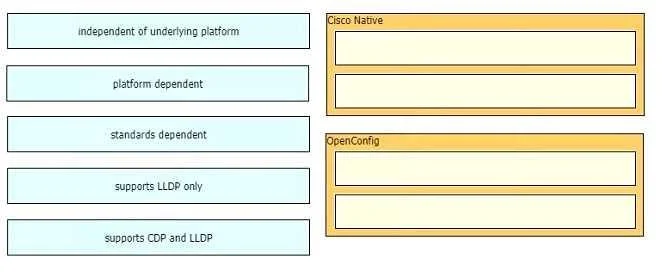
Drag and Drop Question Drag and drop the characteristics from the left onto the YANG modules they describe on the right. Not all options are used. Answer:
The correct answer is Application data is encrypted end-to-end.; It supports end-to-end network segmentation.; Control traffic is fully encrypted and independent from the service provider network.; It is hard to detect sniffing incidents.; The WAN is a flat network with no network segmentation.; CE to PE routing is controlled by the service provider. This question tests knowledge of network programmability concepts by requiring the classification of characteristics for Cisco Native and OpenConfig YANG data models.
Question
Drag and Drop Question Drag and drop the characteristics from the left onto the YANG modules they describe on the right. Not all options are used. Answer:
Exhibit
Answer Area
Drag items
Correct arrangement
- Application data is encrypted end-to-end.
- It supports end-to-end network segmentation.
- Control traffic is fully encrypted and independent from the service provider network.
- It is hard to detect sniffing incidents.
- The WAN is a flat network with no network segmentation.
- CE to PE routing is controlled by the service provider.
Explanation
This question tests knowledge of network programmability concepts by requiring the classification of characteristics for Cisco Native and OpenConfig YANG data models.
Approach. Based on the provided solution image, the correct interaction is as follows: - Drag 'platform dependent' to the 'Cisco Native' target. Cisco Native YANG models are developed by Cisco specifically for their networking devices and operating systems (e.g., IOS XE, NX-OS), making them inherently tied to Cisco's proprietary platforms. - Drag 'supports CDP and LLDP' to the 'Cisco Native' target. Cisco devices support both the proprietary Cisco Discovery Protocol (CDP) and the industry-standard Link Layer Discovery Protocol (LLDP) for neighbor discovery, and their native models reflect this capability. - Drag 'independent of underlying platform' to the 'OpenConfig' target. OpenConfig is a vendor-neutral initiative aiming to define a common set of YANG models for configuring and managing network devices, promoting interoperability across different vendors' hardware. - Drag 'supports LLDP only' to the 'OpenConfig' target. OpenConfig models focus on industry standards to ensure multi-vendor compatibility. LLDP is an IEEE standard protocol for network discovery, while CDP is proprietary to Cisco. Therefore, OpenConfig models would typically define support for LLDP, not CDP. The characteristic 'standards dependent' remains unused, as it is a less precise descriptor compared to the other options which highlight key differentiating factors.
Common mistakes.
- common_mistake. A common mistake would be to confuse the characteristics of proprietary vs. open standards. For example, assigning 'independent of underlying platform' to 'Cisco Native' or 'platform dependent' to 'OpenConfig' would indicate a misunderstanding of their fundamental design philosophies. Similarly, incorrectly associating 'supports CDP and LLDP' with OpenConfig or 'supports LLDP only' with Cisco Native demonstrates a lack of understanding regarding the scope of discovery protocols supported by each model type. OpenConfig emphasizes vendor neutrality and thus standard protocols like LLDP, while Cisco Native models encompass both proprietary (CDP) and standard (LLDP) features relevant to Cisco devices.
Concept tested. The underlying technical concept being tested is the understanding of different YANG data model implementations in network programmability, specifically differentiating between proprietary (Cisco Native) and industry-standard, vendor-neutral (OpenConfig) models, including their platform dependency and supported network protocols.
Topics
Community Discussion
No community discussion yet for this question.