
300-420 · Question #153
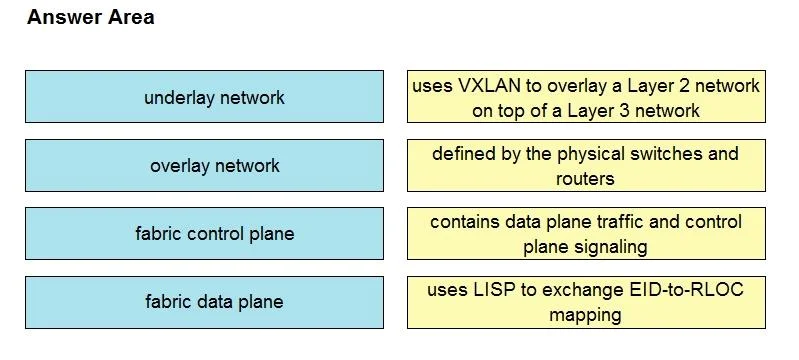
Drag and Drop Question Drag and drop the components in a Cisco SD-Access architecture from the left onto their descriptions on the right. Answer:
The correct answer is platform dependent; supports CDP and LLDP; standards dependent; independent of underlying platform; supports LLDP only. This question assesses knowledge of the core architectural components of Cisco SD-Access and their functions, requiring test-takers to match each component to its correct description.
Question
Drag and Drop Question Drag and drop the components in a Cisco SD-Access architecture from the left onto their descriptions on the right. Answer:
Exhibit
Answer Area
Drag items
Correct arrangement
- platform dependent
- supports CDP and LLDP
- standards dependent
- independent of underlying platform
- supports LLDP only
Explanation
This question assesses knowledge of the core architectural components of Cisco SD-Access and their functions, requiring test-takers to match each component to its correct description.
Approach. The correct approach involves understanding the distinct roles of each component in the Cisco SD-Access architecture and matching them to their corresponding functional descriptions:
- underlay network should be dragged to 'defined by the physical switches and routers': The underlay is the physical infrastructure (switches, routers, cables) that provides the IP connectivity for the fabric.
- overlay network should be dragged to 'uses VXLAN to overlay a Layer 2 network on top of a Layer 3 network': The overlay is the virtualized network that runs on top of the underlay, providing logical separation and leveraging VXLAN for encapsulation.
- fabric control plane should be dragged to 'uses LISP to exchange EID-to-RLOC mapping': The control plane in SD-Access primarily uses LISP (Location/ID Separation Protocol) to manage endpoint-to-location mappings, enabling host mobility and location independence.
- fabric data plane should be dragged to 'contains data plane traffic and control plane signaling': The data plane is responsible for forwarding the actual user data traffic. This traffic, along with certain control plane signaling (e.g., LISP encapsulation headers), is encapsulated (typically with VXLAN) and travels over the underlay/overlay.
Common mistakes.
- common_mistake. A common mistake would be confusing the roles of the control plane and data plane, or misinterpreting the relationship between the underlay and overlay networks. For example, incorrectly matching 'fabric data plane' with 'uses LISP to exchange EID-to-RLOC mapping' would be wrong because LISP is a control plane protocol for mapping, not the mechanism for carrying user data. Similarly, confusing the physical nature of the underlay with the virtual nature of the overlay by swapping their descriptions would be incorrect, as the underlay is the physical infrastructure, while the overlay is the virtual network built upon it using technologies like VXLAN.
Concept tested. Cisco SD-Access architecture components, specifically the roles of the underlay, overlay, fabric control plane (LISP), and fabric data plane (VXLAN encapsulation).
Topics
Community Discussion
No community discussion yet for this question.