
300-085 · Question #171
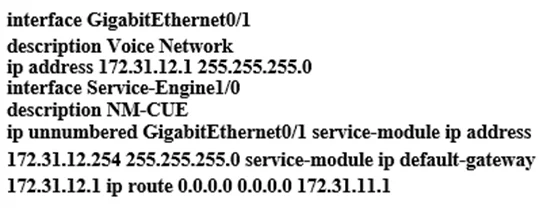
This configuration is found on the Cisco Unified Communications Manager Express router: Which route is needed to complete this configuration?
The correct answer is A. ip route 172.31.12.254 255.255.255.255 Service-Engine1/0. Answer A ('ip route 172.31.12.254 255.255.255.255 Service-Engine1/0') is correct because Cisco Unity Express (CUE) runs on a Network Module (NM-CUE) that is installed inside the router and accessed through an internal Service Engine interface. The Service-Engine1/0 interface is…
Question
This configuration is found on the Cisco Unified Communications Manager Express router:
Which route is needed to complete this configuration?
Exhibit
Options
- Aip route 172.31.12.254 255.255.255.255 Service-Engine1/0
- Bip route 172.31.12.254 255.255.255.255 172.31.12.1
- Cip route 172.31.12.254 255.255.255.255 172.31.12.254
- Dip route 172.31.12.254 255.255.255.255 172.31.11.1
How the community answered
(29 responses)- A83% (24)
- B3% (1)
- C3% (1)
- D10% (3)
Explanation
Answer A ('ip route 172.31.12.254 255.255.255.255 Service-Engine1/0') is correct because Cisco Unity Express (CUE) runs on a Network Module (NM-CUE) that is installed inside the router and accessed through an internal Service Engine interface. The Service-Engine1/0 interface is the logical interface used by IOS to communicate with the CUE module. A host route (/32 mask, shown as 255.255.255.255) pointing to the Service-Engine interface is required so that the router can forward traffic destined for the CUE module's IP address (172.31.12.254) to that internal interface. Answer B is incorrect because routing to 172.31.12.1 would send traffic to an upstream next-hop rather than the internal module. Answer C is incorrect because a route cannot use the destination address itself as the next-hop (recursive loop). Answer D is incorrect because routing to 172.31.11.1 points to a different subnet gateway, not the internal CUE module.
Topics
Community Discussion
No community discussion yet for this question.