
220-1101 · Question #156
A user connects to a wireless network but cannot access the internet. A technician investigates the issue and gathers the following data from a mobile device: Which of the following is the MOST…
The correct answer is B. The mobile device is not receiving an IP address from DHCP. If a mobile device connects to a wireless network but cannot access the internet, the most likely cause is that the device is not receiving an IP address from the DHCP server.
Question
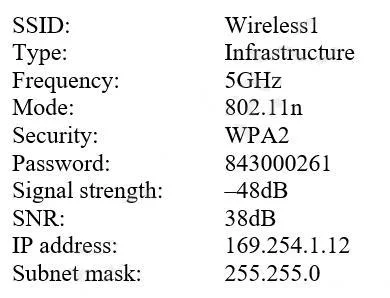
A user connects to a wireless network but cannot access the internet. A technician investigates the issue and gathers the following data from a mobile device:
Which of the following is the MOST likely cause of the issue?
Exhibit
Options
- AWPA2 passwords require characters, of which a minimum of ten is needed.
- BThe mobile device is not receiving an IP address from DHCP.
- CThe SNR is too low for a high-quality connection.
- DThe signal strength is too low for a high-quality connection.
- EThe frequency is not correct for 802.11n.
How the community answered
(32 responses)- A3% (1)
- B72% (23)
- C9% (3)
- D16% (5)
Why each option
If a mobile device connects to a wireless network but cannot access the internet, the most likely cause is that the device is not receiving an IP address from the DHCP server.
If the mobile device is successfully connected to the wireless network, it means the WPA2 password was correctly entered and accepted; password requirements are not relevant once a connection is established.
A device needs an IP address to communicate on a network and access the internet. If the mobile device connects to the Wi-Fi but lacks an IP address (often indicated by a self-assigned address like 169.254.x.x), the DHCP server is failing to assign one, preventing internet access.
A low SNR (Signal-to-Noise Ratio) would typically cause a poor, unstable, or slow connection, but usually would not prevent the device from obtaining an IP address if it can connect to the Wi-Fi at all.
Low signal strength would make it difficult to establish or maintain a stable connection, but the question states the user connects to the network, implying sufficient signal for initial association.
If the frequency was incorrect for 802.11n, the device would be unable to connect to the wireless network at all, as it would not be able to communicate with the access point.
Concept tested: Network troubleshooting - IP addressing
Source: https://learn.microsoft.com/en-us/windows-server/networking/technologies/dhcp/dhcp-overview
Topics
Community Discussion
No community discussion yet for this question.