
200-301 · Question #393
Drag and Drop Question Drag and drop the network protocols from the left onto the correct transport services on the right. Answer:
The correct answer is FTP; SMTP; SSH; SNMP; TFTP; VoIP. Network Protocols -> Transport Service (TCP vs UDP) The question is asking you to classify each protocol by whether it uses TCP or UDP as its transport layer. The arrangement splits into two groups: | # | Protocol | Transport | Why | |---|----------|-----------|-----| | 1 | FTP…
Question
Exhibits
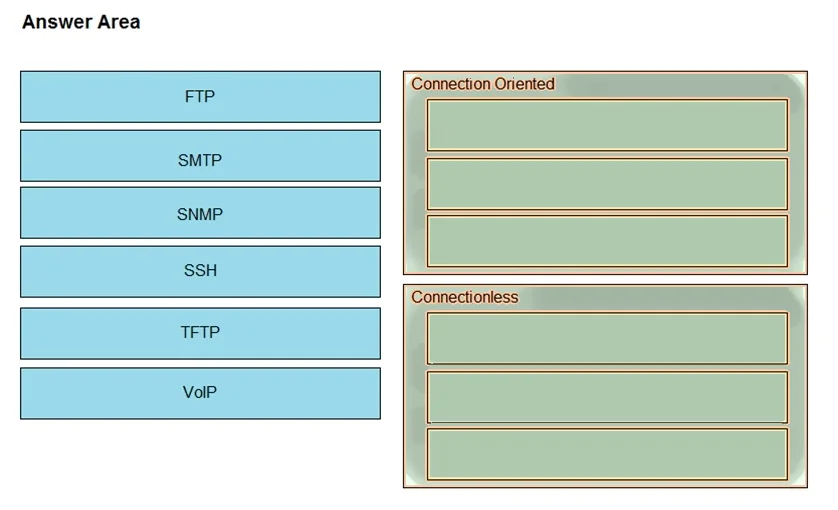
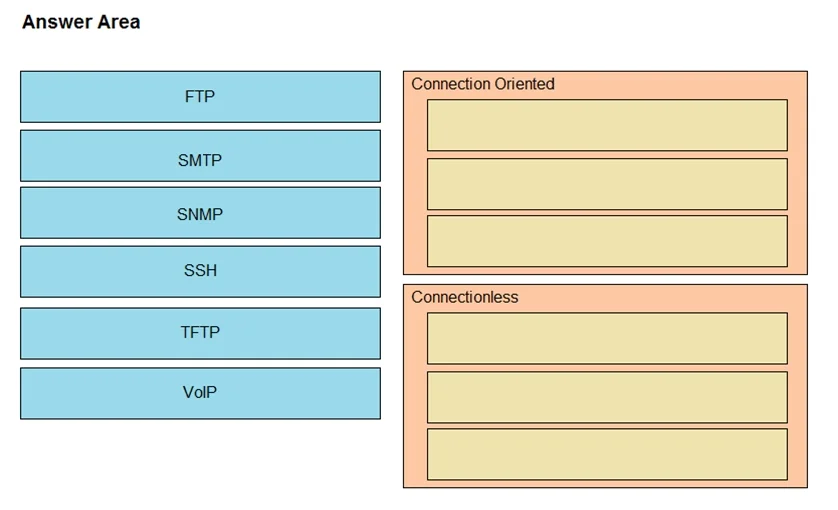
Answer Area
Drag items
Correct arrangement
- FTP
- SMTP
- SSH
- SNMP
- TFTP
- VoIP
Explanation
Network Protocols -> Transport Service (TCP vs UDP)
The question is asking you to classify each protocol by whether it uses TCP or UDP as its transport layer.
The arrangement splits into two groups:
| # | Protocol | Transport | Why |
|---|---|---|---|
| 1 | FTP | TCP | Transfers files - requires reliable, ordered delivery; uses ports 20/21 |
| 2 | SMTP | TCP | Delivers email - must guarantee message integrity; uses port 25 |
| 3 | SSH | TCP | Secure remote shell - session integrity is critical; uses port 22 |
| 4 | SNMP | UDP | Polls device stats - speed over reliability; dropped packets acceptable; port 161 |
| 5 | TFTP | UDP | Simplified file transfer (no auth, no reliability built-in); port 69 |
| 6 | VoIP | UDP | Real-time audio - latency matters more than packet loss; retransmission would cause worse audio |
Why TCP for items 1-3
TCP provides connection-oriented, error-checked, ordered delivery. FTP, SMTP, and SSH all transfer data where completeness and accuracy are non-negotiable - a corrupted file, partial email, or broken shell session are unacceptable.
Why UDP for items 4-6
UDP is connectionless and low-overhead. SNMP, TFTP, and VoIP all prioritize speed or simplicity over guaranteed delivery. VoIP in particular cannot afford TCP's retransmission delays - a late audio packet is worse than a dropped one.
Common Misconceptions
- TFTP vs FTP confusion: Despite the name, TFTP uses UDP - it's intentionally stripped-down, used for booting devices (PXE) where simplicity matters more than reliability.
- SNMP assumed to be TCP: It uses UDP because monitoring traffic is frequent and lightweight; reliability is handled at the application layer if needed.
- VoIP assumed to need TCP: The real-time nature of voice means TCP's retransmission mechanism would introduce unacceptable jitter and delay.
Topics
Community Discussion
No community discussion yet for this question.