
200-301 · Question #1624
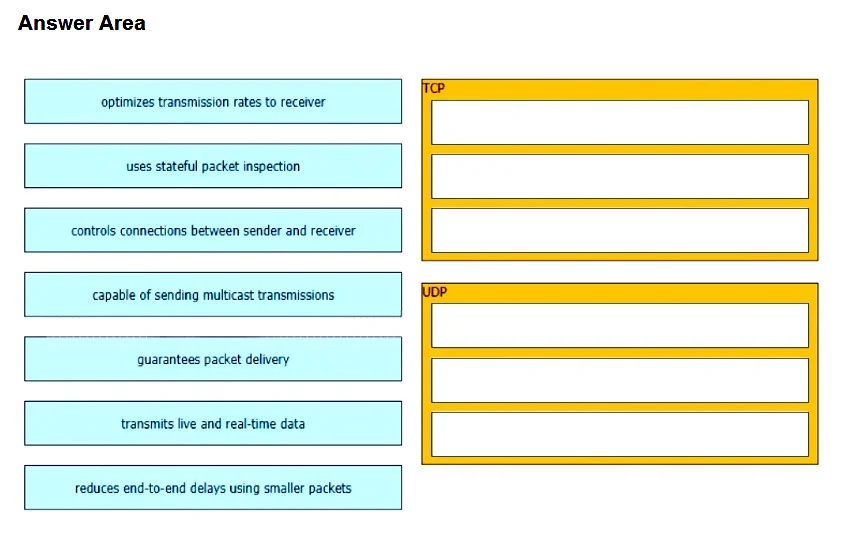
Drag and Drop Question Drag and drop the protocol advantages from the left onto the corresponding types on the right. Not all options are used. Answer:
The correct answer is TCP: optimizes transmission rates to receiver; TCP: controls connections between sender and receiver; TCP: guarantees packet delivery; UDP: capable of sending multicast transmissions; UDP: transmits live and real-time data; UDP: reduces end-to-end delays using smaller packets. TCP vs UDP Protocol Advantages TCP (Transmission Control Protocol) 1. Optimizes transmission rates to receiver TCP uses a sliding window / flow control mechanism that dynamically adjusts how much data is sent based on the receiver's buffer capacity. This prevents the sender…
Question
Exhibit
Answer Area
Drag items
Correct arrangement
- TCP: optimizes transmission rates to receiver
- TCP: controls connections between sender and receiver
- TCP: guarantees packet delivery
- UDP: capable of sending multicast transmissions
- UDP: transmits live and real-time data
- UDP: reduces end-to-end delays using smaller packets
Explanation
TCP vs UDP Protocol Advantages
TCP (Transmission Control Protocol)
1. Optimizes transmission rates to receiver TCP uses a sliding window / flow control mechanism that dynamically adjusts how much data is sent based on the receiver's buffer capacity. This prevents the sender from overwhelming the receiver - a feature UDP simply doesn't have.
2. Controls connections between sender and receiver TCP is connection-oriented - it establishes a session via the 3-way handshake (SYN, SYN-ACK, ACK) before any data is sent, and tears it down gracefully. This "control" of the connection lifecycle is a defining TCP characteristic. UDP is connectionless and fires packets without setup.
3. Guarantees packet delivery TCP uses acknowledgments (ACKs), sequence numbers, and retransmission to ensure every packet arrives and is reassembled in order. UDP makes no such guarantee - packets can be lost, duplicated, or arrive out of order with no correction.
UDP (User Datagram Protocol)
4. Capable of sending multicast transmissions UDP natively supports one-to-many (multicast) delivery. Because UDP has no connection state, a single packet can be addressed to a multicast group and received by multiple hosts simultaneously. TCP's point-to-point connection model makes true multicast impractical.
5. Transmits live and real-time data UDP is preferred for streaming audio/video, VoIP, and gaming because it has minimal overhead and no retransmission delays. For real-time media, a slightly dropped frame is better than waiting for a retransmit - TCP's reliability mechanisms would introduce unacceptable latency.
6. Reduces end-to-end delays using smaller packets UDP has an 8-byte header vs TCP's 20+ byte header. Less overhead per packet means lower per-packet processing cost and reduced latency across the network. TCP headers carry sequence numbers, ACK numbers, window size, flags, etc. - all necessary for reliability but costly for latency-sensitive apps.
The Unused Item: "Uses stateful packet inspection"
Stateful packet inspection (SPI) is a firewall/security feature, not a property of TCP or UDP itself. It's a common distractor - don't confuse it with TCP's stateful connection tracking. SPI operates at the firewall layer regardless of transport protocol.
Common Misconceptions
| Misconception | Reality |
|---|---|
| "UDP is faster, so it optimizes transmission rates" | Speed ≠ optimization. Flow control (TCP) is about adapting to the receiver, not raw speed. |
| "TCP multicast is possible" | TCP requires a dedicated connection per peer - multicast requires UDP. |
| "Real-time data needs reliability, so TCP is better" | Retransmission latency is worse for real-time than occasional packet loss. |
| "SPI belongs to TCP because TCP is stateful" | Stateful inspection is a firewall concept, not a transport-layer feature. |
Topics
Community Discussion
No community discussion yet for this question.