
200-301 · Question #875
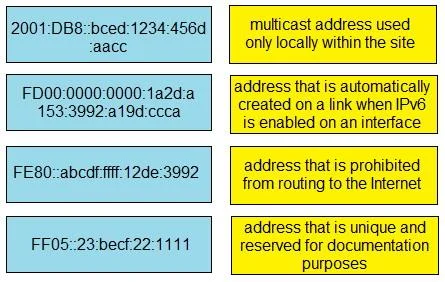
Drag and Drop Question Drag and drop the IPv6 address types from the left onto their description on the right. Answer:
The correct answer is 2001:DB8::bced:1234:456d:aacc; FD00:0000:0000:1a2d:a153:3992:a19d:ccca; FE80::abcd:ffff:12de:3992; FF05::23:becf:22:1111. IPv6 Address Types - Drag and Drop Explanation The question maps each address to its IPv6 address type. The descriptions (not shown) almost certainly read: | # | Description | Address | |---|---|---| | 1 | Global Unicast | 2001:DB8::bced:1234:456d:aacc | | 2 | Unique Local |…
Question
Exhibit
Answer Area
Drag items
Correct arrangement
- 2001:DB8::bced:1234:456d:aacc
- FD00:0000:0000:1a2d:a153:3992:a19d:ccca
- FE80::abcd:ffff:12de:3992
- FF05::23:becf:22:1111
Explanation
IPv6 Address Types - Drag and Drop Explanation
The question maps each address to its IPv6 address type. The descriptions (not shown) almost certainly read:
| # | Description | Address |
|---|---|---|
| 1 | Global Unicast | 2001:DB8::bced:1234:456d:aacc |
| 2 | Unique Local | FD00:0000:0000:1a2d:a153:3992:a19d:ccca |
| 3 | Link-Local | FE80::abcd:ffff:12de:3992 |
| 4 | Multicast | FF05::23:becf:22:1111 |
Item-by-Item Breakdown
1. 2001:DB8::bced:1234:456d:aacc -> Global Unicast
- Prefix
2000::/3(first hex digit2or3) = Global Unicast. 2001:DB8::/32is specifically the documentation/example sub-range (RFC 3849), but it is still a Global Unicast address type.- Global Unicast = publicly routable, the IPv6 equivalent of a public IPv4 address.
- Common mistake: Students think
2001:DB8is a special "documentation-only" type. It is not a separate type - it is just a reserved sub-block within Global Unicast.
2. FD00:0000:0000:1a2d:a153:3992:a19d:ccca -> Unique Local
- Prefix
FC00::/7coversFCandFD. TheFDprefix means the local bit (L-bit) is set, making it a locally assigned Unique Local Address. - Unique Local = private, non-routable on the public internet. IPv6 equivalent of RFC 1918 (
10.x,192.168.x). - Common mistake: Confusing Unique Local (
FD) with Link-Local (FE80). Both are private, but Link-Local is link-scoped only (single segment), while Unique Local is site-scoped and can be routed within an organization.
3. FE80::abcd:ffff:12de:3992 -> Link-Local
- Prefix
FE80::/10always identifies a Link-Local address. - Automatically configured on every IPv6 interface. Never routed beyond the local network segment.
- Used for neighbor discovery (NDP), router advertisements, and default gateway communication.
- Common mistake: Thinking Link-Local and Unique Local are the same. They are not - Link-Local (
FE80) cannot leave the link; Unique Local (FC/FD) can be internally routed.
4. FF05::23:becf:22:1111 -> Multicast
- Any address starting with
FFis Multicast. - The second octet encodes the scope:
FF05= site-local scope. - Multicast replaces IPv4 broadcast - packets are sent to a group of interested listeners, not all hosts.
- Common mistake: Confusing
FF02(link-local multicast) withFF05(site-local multicast). Both are multicast - the scope digit (02vs05) changes how far the packet travels, not the type.
Quick Recognition Cheat Sheet
| Prefix | Type |
|---|---|
2000::/3 (starts with 2 or 3) | Global Unicast |
FC00::/7 (FC or FD) | Unique Local |
FE80::/10 | Link-Local |
FF00::/8 | Multicast |
::1 | Loopback |
Topics
Community Discussion
No community discussion yet for this question.