
200-301 · Question #1625
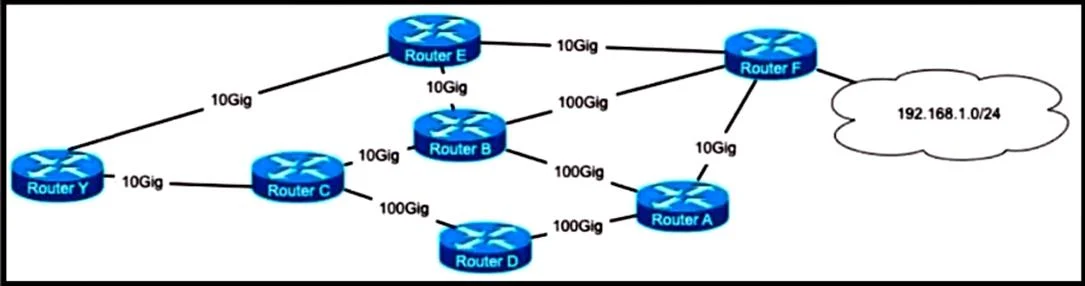
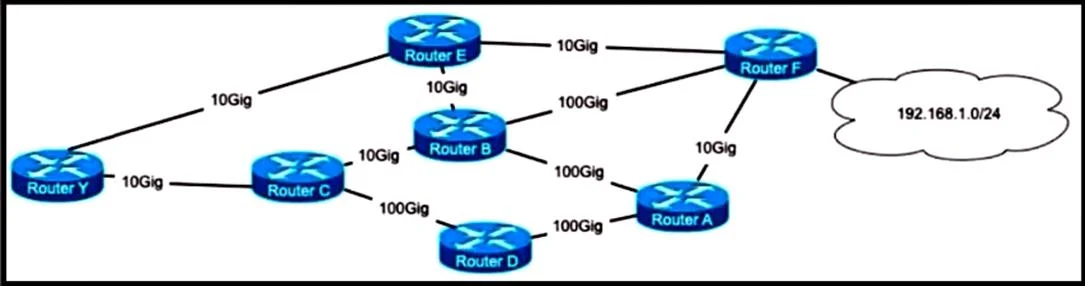
Refer to the exhibit. With a reference bandwidth of 100 Gb on all routers, which path does router Y use to get to network 192.168.1.0/24?
The correct answer is D. router C > D > A > B > F. Router Y selects the path to network 192.168.1.0/24 based on the lowest cumulative OSPF cost, calculated from the reference bandwidth and interface speeds.
Question
Refer to the exhibit. With a reference bandwidth of 100 Gb on all routers, which path does router Y use to get to network 192.168.1.0/24?
Exhibits
Options
- Arouter C > D > A > F
- Brouter E > F
- Crouter E > B > F
- Drouter C > D > A > B > F
How the community answered
(28 responses)- A4% (1)
- B4% (1)
- C11% (3)
- D82% (23)
Why each option
Router Y selects the path to network 192.168.1.0/24 based on the lowest cumulative OSPF cost, calculated from the reference bandwidth and interface speeds.
Path A is incorrect because its cumulative OSPF cost must be higher than path D, implying its links have lower bandwidths and thus higher individual costs.
Path B is incorrect because its shorter hop count does not guarantee a lower OSPF cost; its links likely have lower bandwidths, leading to a higher total cost.
Path C is incorrect because its cumulative OSPF cost, even with three hops, must be higher than path D due to assumed lower bandwidth links and higher individual costs.
Path D, router C > D > A > B > F, is the correct path because OSPF, with a reference bandwidth of 100 Gbps, prioritizes routes with the lowest cumulative cost. Even if this path involves more hops, its links must have higher bandwidth (lower individual OSPF cost) compared to the links in other potential paths, resulting in the lowest overall cost.
Concept tested: OSPF path selection and cost calculation
Source: https://www.cisco.com/c/en/us/support/docs/ip/open-shortest-path-first-ospf/7039-1.html
Topics
Community Discussion
No community discussion yet for this question.