
200-301 · Question #1626
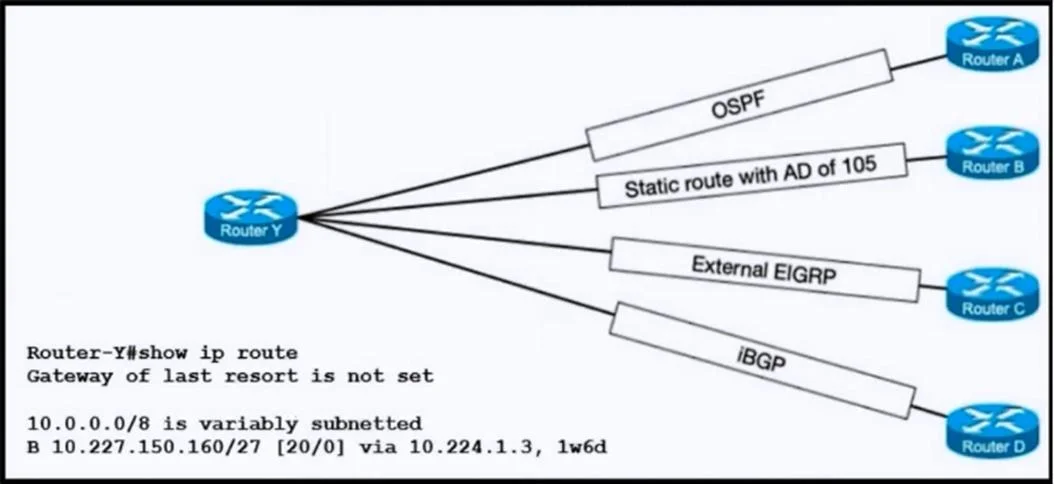
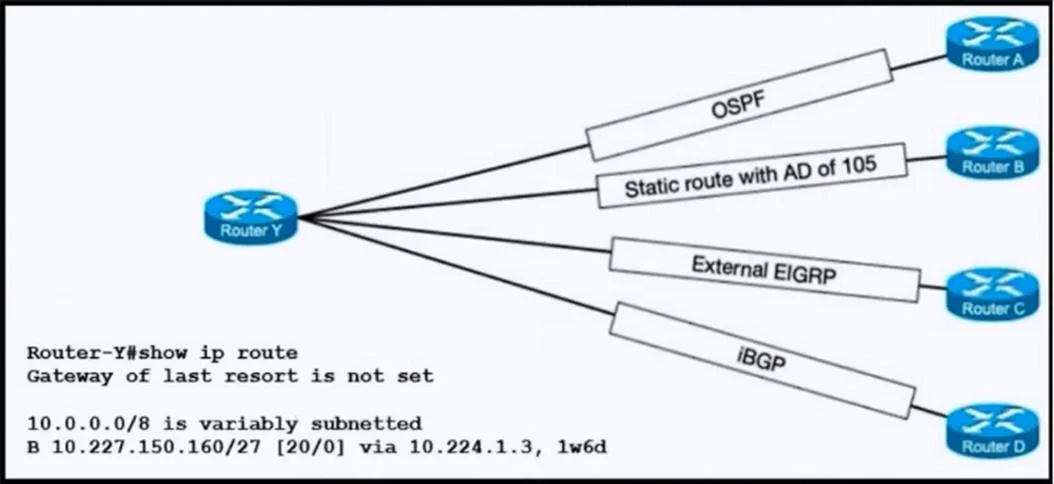
Refer to the exhibit. The route for 10.227.150.160/27 has been very unstable. The same route has four backups to routers A, B, C, and D via the respective methods. The routing protocol defaults for…
The correct answer is A. router B. To determine which router Router Y will use as a backup to route traffic to 10.227.150.160/27, we need to compare the administrative distances (AD) of the various routing methods that connect to routers A, B, C, and D. Routing Protocol Administrative Distances: OSPF (Router A)…
Question
Refer to the exhibit. The route for 10.227.150.160/27 has been very unstable. The same route has four backups to routers A, B, C, and D via the respective methods. The routing protocol defaults for router Y have not been changed. When the current route for 10.227.150.160/27 becomes unavailable, which router will router Y use to route traffic to 10.227.150.160/27?
Exhibits
Options
- Arouter B
- Brouter D
- Crouter C
- Drouter A
How the community answered
(24 responses)- A67% (16)
- B4% (1)
- C17% (4)
- D13% (3)
Explanation
To determine which router Router Y will use as a backup to route traffic to 10.227.150.160/27, we need to compare the administrative distances (AD) of the various routing methods that connect to routers A, B, C, and D. Routing Protocol Administrative Distances: OSPF (Router A): Default AD is 110. Static Route with an AD of 105 (Router B): The AD has been set to 105, making it lower than External EIGRP (Router C): Default AD for external EIGRP is 170. iBGP (Router D): Default AD is 200. The current route to 10.227.150.160/27 is through BGP (as shown by the 'B' in the routing table) via 10.224.1.3 with an AD of 20. This means that when this BGP route becomes unavailable, Router Y will select the next route based on the lowest AD. Backup Route Selection: Router B (Static Route): AD is 105. Router A (OSPF): AD is 110. Router C (External EIGRP): AD is 170. Router D (iBGP): AD is 200. The static route via Router B has the lowest administrative distance (AD of 105) among the available backups. Therefore, when the BGP route becomes unavailable, Router Y will use the static route via Router B to reach 10.227.150.160/27.
Topics
Community Discussion
No community discussion yet for this question.