
200-301 · Question #391
Drag and Drop Question Refer to the exhibit. An engineer is configuring the router to provide static NAT for the webserver. Drag and drop the configuration commands from the left onto the letters…
The correct answer is ip address 172.16.1.1 255.255.255.0; ip nat inside; ip address 45.83.2.214 255.255.255.240; ip nat outside; ip nat inside source static tcp 172.16.1.2 80 45.83.2.214 80 extendable; ip nat inside source list 1 interface s0 overload. The correct configuration places the internal (LAN-side) interface with its private IP address 172.16.1.1 and 'ip nat inside' designation, while the external (WAN-side) interface receives the public IP 45.83.2.214 and 'ip nat outside' designation. The static NAT entry 'ip nat…
Question
Drag and Drop Question Refer to the exhibit. An engineer is configuring the router to provide static NAT for the webserver. Drag and drop the configuration commands from the left onto the letters that correspond to its position in the configuration on the fight. Answer:
Exhibit
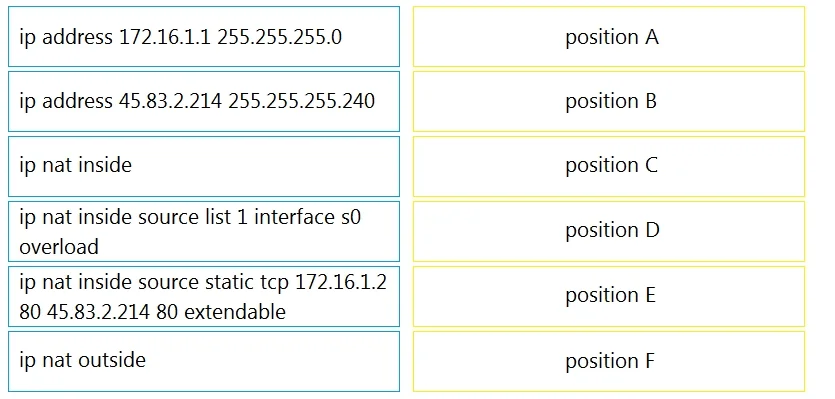
Answer Area
Drag items
Correct arrangement
- ip address 172.16.1.1 255.255.255.0
- ip nat inside
- ip address 45.83.2.214 255.255.255.240
- ip nat outside
- ip nat inside source static tcp 172.16.1.2 80 45.83.2.214 80 extendable
- ip nat inside source list 1 interface s0 overload
Explanation
The correct configuration places the internal (LAN-side) interface with its private IP address 172.16.1.1 and 'ip nat inside' designation, while the external (WAN-side) interface receives the public IP 45.83.2.214 and 'ip nat outside' designation. The static NAT entry 'ip nat inside source static tcp 172.16.1.2 80 45.83.2.214 80 extendable' maps the webserver's private IP and port 80 to the public IP and port 80, enabling external access to the internal webserver. This is classic static port-based NAT (PAT) where a specific TCP service is published externally using a one-to-one port mapping.
Topics
Community Discussion
No community discussion yet for this question.