
200-301 · Question #1397
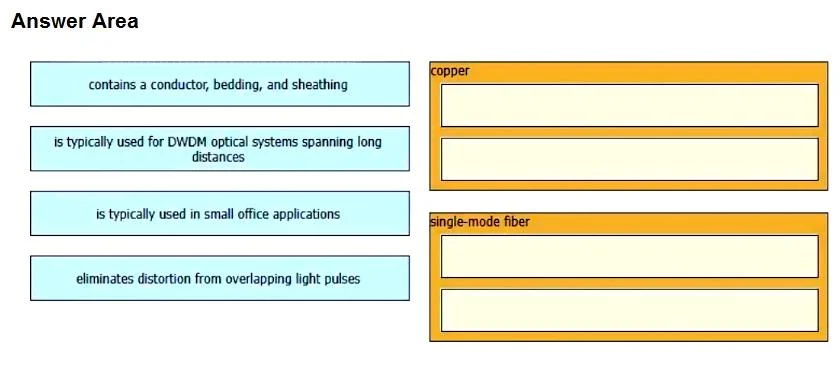
Drag and Drop Question Drag and drop the characteristic from the left onto the cable type on the right. Answer:
The correct answer is contains a conductor, bedding, and sheathing; is typically used in small office applications; is typically used for DWDM optical systems spanning long distances; eliminates distortion from overlapping light pulses. Cable Type Characteristics - Drag-and-Drop Explanation The question maps four characteristics to four cable types. The cable types on the right (implied by context) are, in order: | Position | Cable Type | Characteristic | |----------|-----------|----------------| | 1 | Coaxial…
Question
Exhibit
Answer Area
Drag items
Correct arrangement
- contains a conductor, bedding, and sheathing
- is typically used in small office applications
- is typically used for DWDM optical systems spanning long distances
- eliminates distortion from overlapping light pulses
Explanation
Cable Type Characteristics - Drag-and-Drop Explanation
The question maps four characteristics to four cable types. The cable types on the right (implied by context) are, in order:
| Position | Cable Type | Characteristic |
|---|---|---|
| 1 | Coaxial cable | contains a conductor, bedding, and sheathing |
| 2 | UTP (Unshielded Twisted Pair) | is typically used in small office applications |
| 3 | Single-Mode Fiber (SMF) | is typically used for DWDM optical systems spanning long distances |
| 4 | Multi-Mode Fiber (MMF) | eliminates distortion from overlapping light pulses |
Item-by-Item Breakdown
1. "contains a conductor, bedding, and sheathing" -> Coaxial Coaxial cable has a distinct layered structure: inner copper conductor -> dielectric insulation (bedding) -> braided shield -> outer plastic sheathing. No other common cable type uses this exact layered terminology. UTP has no bedding layer; fiber has no conductor.
2. "is typically used in small office applications" -> UTP UTP (Cat5e/Cat6) is the standard for SOHO (Small Office/Home Office) Ethernet deployments due to low cost, ease of installation, and adequate performance for short runs. Fiber is overkill for small office LANs; coax is legacy.
3. "is typically used for DWDM optical systems spanning long distances" -> Single-Mode Fiber DWDM (Dense Wavelength Division Multiplexing) requires SMF because its narrow 9µm core supports a single propagation mode, allowing many wavelength channels to be multiplexed without inter-channel interference over distances of hundreds to thousands of kilometers. MMF's larger core (50-62.5µm) causes modal dispersion that makes it unsuitable for DWDM or long hauls.
4. "eliminates distortion from overlapping light pulses" -> Multi-Mode Fiber This refers to modal dispersion - where different light modes travel different path lengths and arrive at slightly different times, causing pulse spreading ("overlapping"). Modern graded-index MMF uses a variable refractive index profile that equalizes the travel time of different modes, significantly reducing this distortion. This is the defining design advantage of graded-index MMF over older step-index MMF.
Common Misconceptions
-
Confusing SMF and MMF on items 3 & 4: This is the most frequent error. Students often assign "eliminates distortion from overlapping light pulses" to SMF (which does completely eliminate modal dispersion by having only one mode). However, in exam context, this characteristic is used to describe graded-index MMF's purpose - it was engineered specifically to address modal dispersion. SMF is identified by the DWDM/long-distance clue instead.
-
Misidentifying coaxial structure: Some students confuse coaxial with STP (Shielded Twisted Pair). STP has a foil/braid shield, but its structure is described differently - coaxial is the one with the concentric layered construction using "bedding."
-
UTP vs. MMF for "small office": MMF is sometimes used intra-building, but "small office" on exams almost always signals UTP/copper Ethernet, not fiber.
Topics
Community Discussion
No community discussion yet for this question.