
200-301 · Question #1253
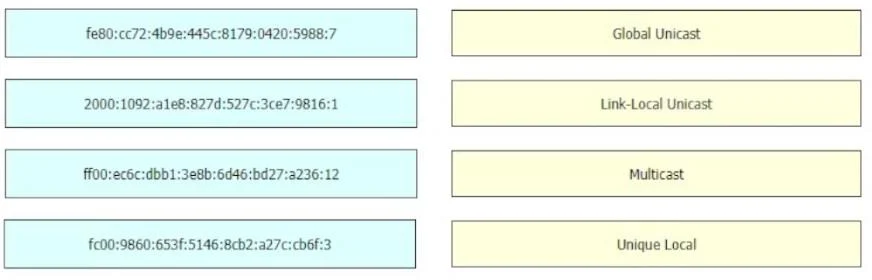
Drag and Drop Question Drag and drop the IPv6 address from the left onto the type on the right. Answer:
The correct answer is 2000:1092:a1e8:827d:527c:3ce7:9816:1; fe80:cc72:4b9e:445c:8179:0420:5988:7; ff00:ec5c:dbb1:3e8b:6d46:bd27:a236:12; ff00:9860:653f:5146:8cb2:a27c:cbf3. IPv6 Address Type Classification The question asks you to match each IPv6 address to its type based on its prefix - the first few bits/characters determine the address type. The type labels on the right (not shown in your question) are the standard IPv6 address categories…
Question
Drag and Drop Question Drag and drop the IPv6 address from the left onto the type on the right. Answer:
Exhibit
Answer Area
Drag items
Correct arrangement
- 2000:1092:a1e8:827d:527c:3ce7:9816:1
- fe80:cc72:4b9e:445c:8179:0420:5988:7
- ff00:ec5c:dbb1:3e8b:6d46:bd27:a236:12
- ff00:9860:653f:5146:8cb2:a27c:cbf3
Explanation
IPv6 Address Type Classification
The question asks you to match each IPv6 address to its type based on its prefix - the first few bits/characters determine the address type. The type labels on the right (not shown in your question) are the standard IPv6 address categories.
The Key Rule: IPv6 Address Type is Determined by its Prefix
| Prefix | Type |
|---|---|
2000::/3 (range 2000:: - 3FFF::) | Global Unicast |
FE80::/10 | Link-Local Unicast |
FF00::/8 | Multicast |
Item-by-Item Breakdown
Position 1: 2000:1092:a1e8:827d:527c:3ce7:9816:1 -> Global Unicast
- Starts with
2000, which falls in the2000::/3range (binary001xxxxx...) - Global unicast = routable on the public internet, analogous to a public IPv4 address
- Common mistake: confusing this with "public" IPv4 - the concept maps over, but the prefix range (
2000::to3FFF::) is what defines it
Position 2: fe80:cc72:4b9e:445c:8179:0420:5988:7 -> Link-Local Unicast
- Starts with
fe80, which is always in theFE80::/10block - Link-local addresses are non-routable - only valid on the local network segment
- Analogous to IPv4 APIPA (
169.254.x.x) - Common mistake: thinking
fe80addresses can be routed across the internet - they cannot
Position 3: ff00:ec5c:dbb1:3e8b:6d46:bd27:a236:12 -> Multicast
- Starts with
ff, placing it firmly inFF00::/8 - Any address beginning with
FFis multicast - sent to a group of interfaces, not one - Common mistake: confusing multicast (
FF::) with broadcast - IPv6 has no broadcast; multicast replaces it
Position 4: ff00:9860:653f:5146:8cb2:a27c:cbf3 -> Multicast
- Also starts with
ff00- same type as Position 3 - If the exam distinguishes these two, it's likely by scope (nibble 4 of the address:
ff[flags][scope]::) -ff00means scope=0 (reserved/node-local), whileff02= link-local scope,ff0e= global scope
Common Misconceptions
fe80vsff00: Link-local starts withfe8, multicast starts withff- easy to mix up visually- Two multicast addresses: Both
ff00:ec5c...andff00:9860...are multicast; if the exam expects different placements, look at the full second byte for scope differences - No Loopback here: IPv6 loopback is
::1(exactly) - none of these are loopback - No Anycast: Anycast addresses share the same prefix space as global unicast and are distinguished only by configuration, not by address format alone
Topics
Community Discussion
No community discussion yet for this question.