
132-S-715.1 · Question #10
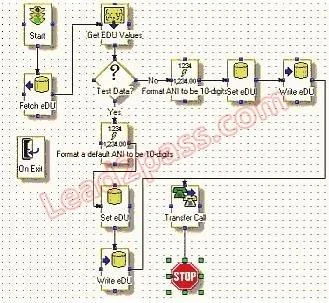
Click the exhibit button. The exhibit shows a simple incoming call workflow. On an incoming call you check for a valid ANI. If you have a valid ANI, you format it to 10 digits, write it into the…
The correct answer is D. Use one Set EDU block and one Write EDU block to achieve the same functionality of the flow. Avaya 132-S-715.1 Exam
Question
Click the exhibit button. The exhibit shows a simple incoming call workflow. On an incoming call you check for a valid ANI. If you have a valid ANI, you format it to 10 digits, write it into the EDU, and transfer the call. If you do not have a valid ANI, you format the default ANI to 10 digits, write it into the EDU, and transfer the call. Which modification will improve the efficiency of this flow?
Exhibit
Options
- AYou remove the On Exit block.
- BThe Write EDU block should be placed before the Set EDU block.
- CYou add a third Write EDU block to reduce the buffer size overhead.
- DUse one Set EDU block and one Write EDU block to achieve the same functionality of the flow.
How the community answered
(22 responses)- A18% (4)
- B5% (1)
- C5% (1)
- D73% (16)
Explanation
Avaya 132-S-715.1 Exam
Topics
Community Discussion
8 Imani T.Oct 26, 2025
D is the right call here and it makes complete sense once you think about what the flow is actually doing. Both branches, valid ANI and no valid ANI, are doing the exact same thing at the end: formatting to 10 digits, writing to the EDU, and transferring. The only difference between the two paths is HOW you get that 10-digit ANI, not what happens after you have it. So you let the conditional handle just the formatting step, converge both paths into a single Set EDU block followed by a single Write EDU block, and you cut the redundancy in half without changing the logic at all. Less blocks means less to maintain, less to troubleshoot, and a cleaner flow that any other developer can read in 30 seconds.
 Hiroshi T.Oct 18, 2025
D is correct. Both branches perform identical downstream operations (format, write EDU, transfer), so consolidating them into a single shared Set EDU block and Write EDU block after the branch merge eliminates redundant blocks and reduces the overall node count without changing call behavior, which is exactly the kind of flow optimization Genesys documentation recommends for maintaining clean and efficient routing strategies.
 Mei-Ling H.Oct 20, 2025
Hiroshi is right that consolidating shared logic after a merge cuts redundant blocks, but worth noting the order matters here, because if the two branches set EDU fields differently before the merge point you will overwrite one branch's values with a shared Set EDU block, so always confirm the pre-merge field values are truly identical, not just the block types.
Mei-Ling H.Oct 23, 2025I first picked B because I thought the order of Set and Write blocks was the trap, but then I noticed the word "one" in option D and realized both branches do the exact same Write EDU and transfer at the end, so you only need to branch for the Set EDU step and then rejoin into a single Write EDU block instead of repeating it twice.
Imani T.Oct 25, 2025That read is solid, though worth being precise that the merge-and-rejoin only works cleanly if the Write EDU and transfer steps have no dependency on which branch set the value, so confirm that before collapsing them.
 Zsofia N.Nov 9, 2025
Took 132-S-715.1 twice, both times D jumps out because the Set and Write pair only needs to run once after both branches rejoin.
 Toby R.Oct 8, 2025
The Write EDU has to know what to write, so Set has to come first.
Hiroshi T.Oct 9, 2025Toby, D is correct because the Write EDU operation derives its content from the EDU record itself, not from a preceding Set, so sequencing Set before Write EDU is not a requirement the spec defines. The official documentation shows the two are independent operations, and placing Set first does not satisfy any dependency for Write EDU to function.