
VCP550 · Question #75
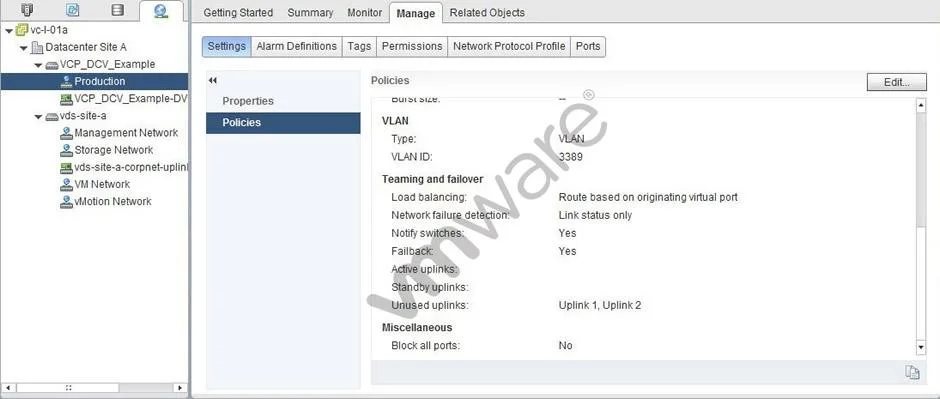
The administrator needs to modify the problematic configuration shown in the exhibit to meet the following requirements: 1. Uplink ports must connect to a 2-port Etherchannel connection. 2. Traffic…
The correct answer is A. Change the Load balancing algorithm to Route based on ip hash D. Move both uplinks into the Active Uplinks. EtherChannel (link aggregation) on a vDS requires the 'Route based on IP hash' load balancing algorithm and all participating uplinks must be placed in the Active Uplinks group.
Question
Exhibit
Options
- AChange the Load balancing algorithm to Route based on ip hash
- BChange the Load balancing algorithm to Route based on physical NIC load
- CMove Uplink 1 into Active Uplinks and Uplink 2 into Standby Uplinks
- DMove both uplinks into the Active Uplinks
How the community answered
(33 responses)- A52% (17)
- B30% (10)
- C18% (6)
Why each option
EtherChannel (link aggregation) on a vDS requires the 'Route based on IP hash' load balancing algorithm and all participating uplinks must be placed in the Active Uplinks group.
Route based on IP hash is the only load balancing algorithm compatible with EtherChannel/LACP because it distributes traffic across member NICs using a hash of source and destination IP addresses, matching the distribution logic used by the physical switch to keep flows consistent and prevent out-of-order packets.
Route based on physical NIC load dynamically shifts traffic based on observed utilization, but it is incompatible with EtherChannel because the physical switch expects a consistent IP-hash-based distribution and will drop or loop frames if the vDS uses a different algorithm.
Placing Uplink 2 in Standby Uplinks removes it from the active EtherChannel bundle; EtherChannel does not support standby/failover members, so the physical switch would not form the channel correctly.
EtherChannel requires all member links to be simultaneously active; placing both uplinks in Active Uplinks allows the physical switch to treat them as a single logical bundle, satisfying both the 2-port EtherChannel requirement and the traffic continuity requirement during a single port failure.
Concept tested: vDS EtherChannel configuration with IP hash load balancing
Source: https://docs.vmware.com/en/VMware-vSphere/7.0/com.vmware.vsphere.networking.doc/GUID-959E1CFE-2AE4-4A67-AFCB-D57BE667523C.html
Topics
Community Discussion
No community discussion yet for this question.