
PL-100 · Question #135
Drag and Drop Question You have a canvas app that uses multiple inputs for calculations. You must use Test Studio to create automated tests and confirm that the app works as expected. You need to…
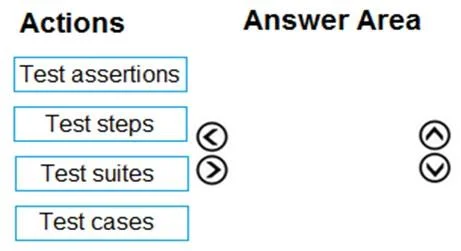
The correct answer is Test suites; Test cases; Test steps; Test assertions. The question asks for the correct hierarchical order of test components in Power Apps Test Studio, from the broadest organizational unit to the most granular validation check.
Question
Exhibit
Answer Area
Drag items
Correct arrangement
- Test suites
- Test cases
- Test steps
- Test assertions
Explanation
The question asks for the correct hierarchical order of test components in Power Apps Test Studio, from the broadest organizational unit to the most granular validation check.
Approach. The correct interaction is to drag the actions into the 'Answer Area' and arrange them in the following order from top to bottom: 'Test suites', 'Test cases', 'Test steps', and 'Test assertions'. This order reflects the standard hierarchical structure for organizing automated tests in Power Apps Test Studio and generally in software testing frameworks.
- Test suites: These are the highest-level containers, used to group related test cases for a particular feature or set of functionalities.
- Test cases: Each test case represents a specific scenario or path that needs to be tested within the application. A test suite can contain multiple test cases.
- Test steps: Within each test case, test steps define the individual actions performed during the test, such as navigating to a screen, entering data into a text input, or clicking a button.
- Test assertions: These are the most granular elements, embedded within test steps. Assertions validate the expected outcome of a step, for example, confirming that a label displays the correct value, a control is visible, or a calculation results in the correct number.
Common mistakes.
- common_mistake. A common mistake is to misunderstand the scope and nesting of these testing components. Placing 'Test assertions' above 'Test steps' would be incorrect because assertions are specific checks within a step, not standalone entities above them. Similarly, arranging 'Test cases' above 'Test suites' would invert the logical grouping, as suites are designed to encompass multiple cases. Any order that deviates from the 'Suite -> Case -> Step -> Assertion' hierarchy would be incorrect, as it would not accurately represent the organizational structure used for managing and executing automated tests.
Concept tested. The core concept being tested is the understanding of the hierarchical structure for organizing automated tests within Power Apps Test Studio, encompassing Test Suites, Test Cases, Test Steps, and Test Assertions. This tests knowledge of fundamental test automation principles and the specific implementation within the Microsoft Power Platform.
Topics
Community Discussion
No community discussion yet for this question.