
NSE4_FGT-7.0 · Question #125
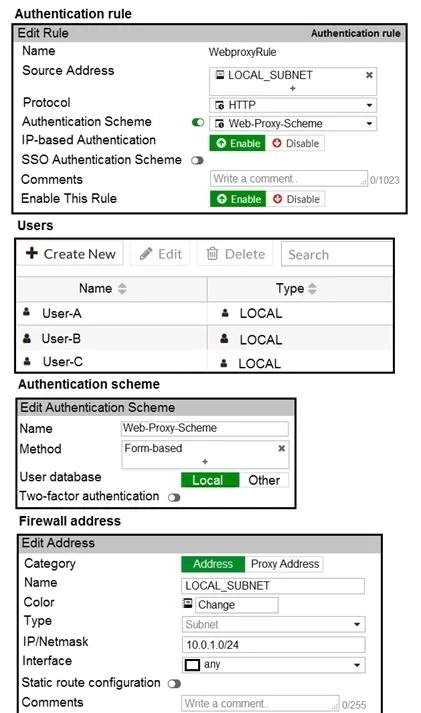
Refer to the exhibit. The exhibit shows proxy policies and proxy addresses, the authentication rule and authentication scheme, users, and firewall address. An explicit web proxy is configured for…
The correct answer is B. If a Google Chrome browser is used with User-B credentials, the HTTP request will be allowed. D. If a Microsoft Internet Explorer browser is used with User-B credentials, the HTTP request will be. When explicit web proxy is configured with form-based authentication and a valid user (User-B) authenticates, HTTP requests will be allowed regardless of the browser, provided policies permit.
Question
Refer to the exhibit. The exhibit shows proxy policies and proxy addresses, the authentication rule and authentication scheme, users, and firewall address. An explicit web proxy is configured for subnet range 10.0.1.0/24 with three explicit web proxy policies. The authentication rule is configured to authenticate HTTP requests for subnet range 10.0.1.0/24 with a form-based authentication scheme for the FortiGate local user database. Users will be prompted for authentication. How will FortiGate process the traffic when the HTTP request comes from a machine with the
Exhibit
Options
- AIf a Mozilla Firefox browser is used with User-B credentials, the HTTP request will be allowed.
- BIf a Google Chrome browser is used with User-B credentials, the HTTP request will be allowed.
- CIf a Mozilla Firefox browser is used with User-A credentials, the HTTP request will be allowed.
- DIf a Microsoft Internet Explorer browser is used with User-B credentials, the HTTP request will be
How the community answered
(27 responses)- A30% (8)
- B59% (16)
- C11% (3)
Why each option
When explicit web proxy is configured with form-based authentication and a valid user (User-B) authenticates, HTTP requests will be allowed regardless of the browser, provided policies permit.
Given that options B and D are correct, it is highly probable that Mozilla Firefox, which also supports form-based authentication, would allow the request with valid User-B credentials unless a specific, unstated exhibit detail prevents it.
If User-B is a valid user in the local database and successfully authenticates via form-based authentication, a Google Chrome browser will be able to submit credentials, and the request will be allowed by policy.
This option refers to 'User-A'; if User-A is not a valid user or lacks the necessary permissions within the explicit web proxy policies, their HTTP request will not be allowed.
Similarly, if User-B successfully authenticates through the form-based scheme, a Microsoft Internet Explorer browser will also successfully submit credentials, and the HTTP request will be allowed.
Concept tested: FortiGate explicit proxy authentication and policy
Source: https://docs.fortinet.com/document/fortigate/7.4.0/fortios-handbook/316335/authentication
Topics
Community Discussion
No community discussion yet for this question.