
NSE4_FGT-7.0 · Question #124
Refer to the exhibit, which contains a session diagnostic output. Which statement is true about the session diagnostic output?
The correct answer is B. The session is in TCP ESTABLISHED state. The diagnostic output confirms a TCP connection has successfully completed its handshake, indicating it is in the ESTABLISHED state and ready for bidirectional data transfer.
Question
Refer to the exhibit, which contains a session diagnostic output. Which statement is true about the session diagnostic output?
Exhibit
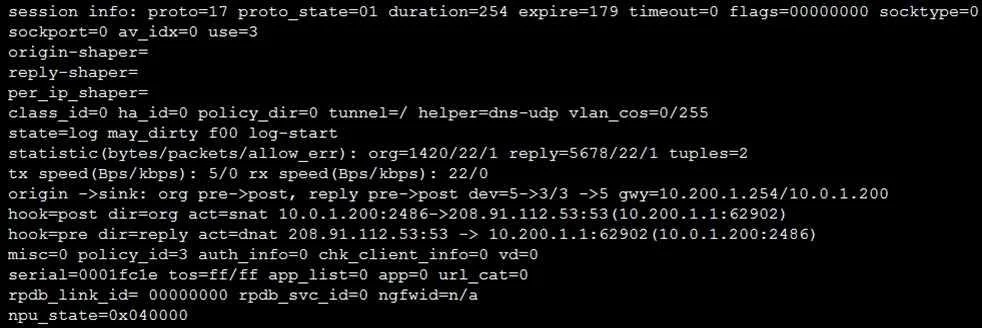
Options
- AThe session is a UDP unidirectional state.
- BThe session is in TCP ESTABLISHED state.
- CThe session is a bidirectional UDP connection.
- DThe session is a bidirectional TCP connection.
How the community answered
(20 responses)- B85% (17)
- C5% (1)
- D10% (2)
Why each option
The diagnostic output confirms a TCP connection has successfully completed its handshake, indicating it is in the ESTABLISHED state and ready for bidirectional data transfer.
UDP is a connectionless protocol and does not maintain persistent states like 'unidirectional' or 'bidirectional' in the same manner as TCP, nor does it establish a connection state.
The session diagnostic output typically includes fields like 'proto=6' (for TCP) and a specific state indicator (e.g., 'state=0000000000_0000000000' or flags like 'ack_rcv=1') which signify that the TCP three-way handshake has been completed, thus establishing the connection.
UDP is connectionless and does not establish a persistent 'bidirectional connection' state like TCP; it simply transmits datagrams without prior connection establishment.
While TCP is inherently bidirectional, stating it is in the ESTABLISHED state is more precise than simply 'bidirectional TCP connection,' as TCP progresses through multiple states before becoming established.
Concept tested: Interpreting FortiGate session states
Source: https://docs.fortinet.com/document/fortigate/7.4.0/fortios-handbook/381534/diagnosing-tcp-session-synchronization-issues
Topics
Community Discussion
No community discussion yet for this question.