
MB-335 · Question #146
Drag and Drop Question A company uses distributed hybrid topology within their Dynamics 365 Supply Chain Management system. The company plans to build a manufacturing plant on a mountain to be…
The correct answer is Case management; Workflow; Document management; Product change. Important Note: Question Mismatch The scenario text (edge scale units, distributed hybrid topology, mountain plant, connectivity) does not match the available items. Those items belong to Engineering Change Management (ECM) in D365 SCM - a completely different feature. This…
Question
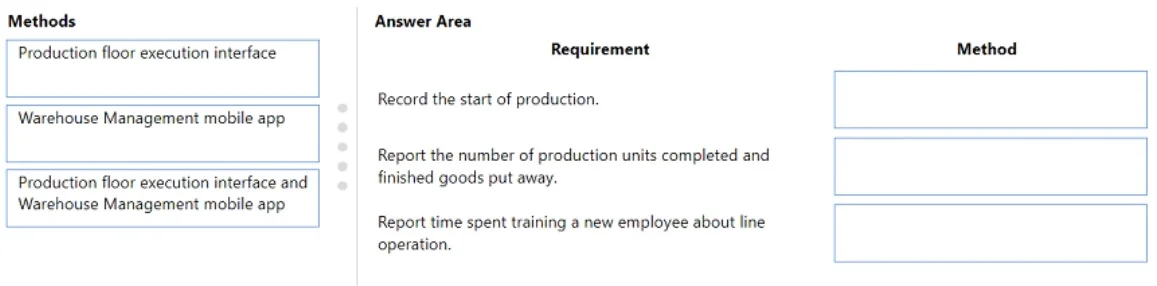
Drag and Drop Question A company uses distributed hybrid topology within their Dynamics 365 Supply Chain Management system. The company plans to build a manufacturing plant on a mountain to be closer to a required mineral source. Internet connectivity is unreliable, and availability of bandwidth speed is limited. The company plans to deploy an operational edge scale unit for the plant to address the connectivity issue. You need to determine where production operations can be performed. Which method should you recommend? To answer, drag the appropriate methods to the correct requirements. Each method may be used once, more than once, or not at all. You may need to drag the split bar between panes or scroll to view content. NOTE: Each correct selection is worth one point. Answer:
Exhibit
Answer Area
Drag items
Correct arrangement
- Case management
- Workflow
- Document management
- Product change
Explanation
Important Note: Question Mismatch
The scenario text (edge scale units, distributed hybrid topology, mountain plant, connectivity) does not match the available items. Those items belong to Engineering Change Management (ECM) in D365 SCM - a completely different feature. This appears to be two separate exam questions merged together. I'll explain both contexts.
The Correct Arrangement Explained (ECM Context)
The 4 items represent the Engineering Change Management process flow - the lifecycle of a product change request:
1. Case Management
Role: The process starts here. An engineering change request is logged as a case. It captures the problem/need, assigns ownership, and tracks status.
Why first: You cannot initiate a formal change without a tracked request. Case management is the intake mechanism.
2. Workflow
Role: The change request moves through an approval workflow - routed to engineers, managers, or quality teams for sign-off.
Why second: Approval must happen after the request is logged and before documents are finalized or changes are applied.
3. Document Management
Role: Supporting files (specs, drawings, test results) are attached and versioned throughout the change process.
Why third: Documents are gathered/finalized once the change is approved in principle, before execution.
4. Product Change
Role: The approved change is applied - updating BOMs, routes, or product definitions via an engineering change order (ECO).
Why last: The actual product data change is the final step, only executed after approval and documentation are complete.
Common Mistakes
| Mistake | Correction |
|---|---|
| Putting Workflow first | Workflow operates on a case - the case must exist first |
| Confusing BOM Designer as part of this flow | BOM Designer is a viewing/editing tool, not a change management step |
| Thinking Product Change and BOM version are the same | A product change triggers a new BOM version, but they are distinct concepts |
| Placing Where-used in the flow | Where-used is an impact analysis lookup, not a process step |
The Actual Edge Scale Unit Answer (Separate Question)
For the connectivity/edge scenario: production operations on an operational edge scale unit can run locally at the plant (disconnected from the hub), while hub operations remain centralized. The edge handles shop floor execution; the hub handles planning. That answer requires different items entirely - not the ECM list shown here.
Topics
Community Discussion
No community discussion yet for this question.