
MB-330 · Question #391
Drag and Drop Question A company uses Dynamics 365 Supply Chain Management. The company purchased a high-tech machine that cuts production time in half compared to existing machines. The new machine…
The correct answer is Sub ledger; Per cost group. Important Caveat This question has a significant mismatch between the scenario and the answer options. The scenario describes machine maintenance prioritization and service scheduling (Asset Management / Production Control concepts), but the available answer options - No…
Question
Exhibit
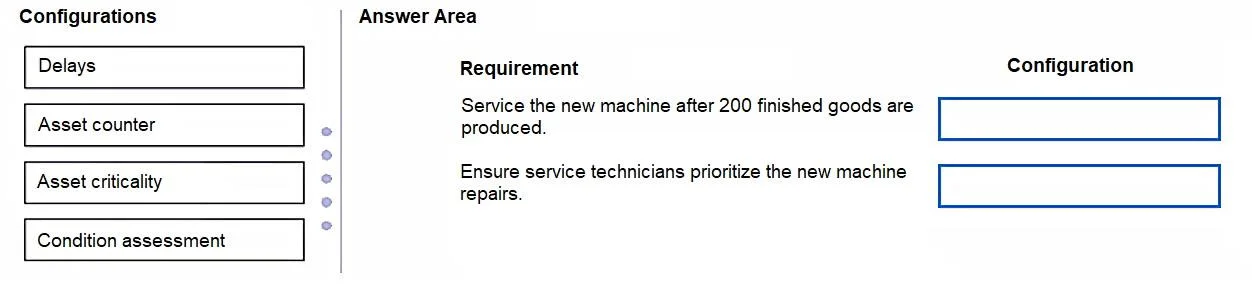
Answer Area
Drag items
Correct arrangement
- Sub ledger
- Per cost group
Explanation
Important Caveat
This question has a significant mismatch between the scenario and the answer options. The scenario describes machine maintenance prioritization and service scheduling (Asset Management / Production Control concepts), but the available answer options - No, Summarized, Sub ledger, Per cost group - are cost posting configuration values from D365 SCM's costing setup (typically found in Indirect Costs or Production Posting configurations). This suggests the question was either assembled incorrectly or is missing context about what specific configuration fields are being matched.
That said, here is the best technical explanation of the correct answers given:
What the Options Mean in D365 SCM
These four values (No, Summarized, Sub ledger, Per cost group) appear as Posting field options when configuring indirect costs or machine/resource cost contributions. They control how production costs are recorded in the ledger.
| Option | Meaning |
|---|---|
| No | Costs are not posted to the ledger at all |
| Summarized | All costs are combined into one ledger entry |
| Sub ledger | Costs are posted to a sub-ledger before rolling up to the GL - provides transaction-level detail |
| Per cost group | Costs are posted separately, broken out by cost group classification |
Placement Explanations
1. Sub ledger
Requirement mapped: Tracking the new high-tech machine's costs with sufficient detail (e.g., distinguishing its maintenance/service costs from other machines).
Why Sub ledger: Posting to a sub-ledger creates a detailed audit trail at the transaction level before costs roll up to the General Ledger. This is appropriate when the machine has unique cost tracking needs - such as a premium machine whose downtime and service costs need to be monitored separately and precisely. It enables cost isolation without losing visibility.
2. Per cost group
Requirement mapped: Breaking down the machine's costs by category (e.g., separating labor, materials, overhead for servicing).
Why Per cost group: Per cost group causes each cost category (direct material, direct labor, overhead, etc.) to be posted with its own ledger entry, distinguished by cost group. This is appropriate when the business needs granular cost visibility across cost types - for example, distinguishing machine service labor costs from spare parts costs, which supports better production lead time and cost planning.
Common Mistakes
- Choosing
Summarizedwhen detail is needed - Summarized collapses everything into one line, making it impossible to isolate the new machine's costs from others. - Choosing
No- This skips posting entirely, which is never appropriate when financial traceability of a capital asset is required. - Confusing
Sub ledgerwithPer cost group- Sub ledger is about transaction granularity in the ledger hierarchy; Per cost group is about categorization by cost type. They answer different questions.
Bottom line: If this question appeared on a real exam, the intended mapping is that detailed ledger traceability = Sub ledger, and cost-type breakdown = Per cost group. However, be aware this question appears to conflate machine maintenance scheduling concepts with cost posting configuration, which is a conceptual error in the question itself.
Topics
Community Discussion
No community discussion yet for this question.