
MB-330 · Question #387
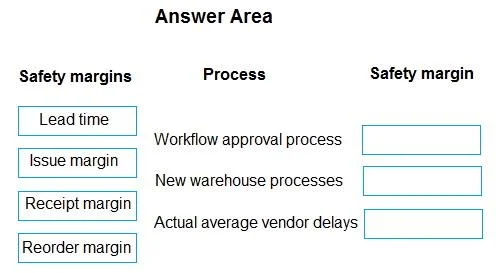
Drag and Drop Question A company is implementing Dynamics 365 Supply Chain Management for new warehouse management operations. A three-tier workflow is being implemented for planned order approval…
Dynamics 365 SCM: Safety Margins Explained The Three Safety Margins In D365 SCM Master Planning, safety margins add buffer days to protect against predictable delays at different points in the supply chain: | Margin | Where it acts | Purpose | |---|---|---| | Reorder margin |…
Question
Exhibit
Explanation
Dynamics 365 SCM: Safety Margins Explained
The Three Safety Margins
In D365 SCM Master Planning, safety margins add buffer days to protect against predictable delays at different points in the supply chain:
| Margin | Where it acts | Purpose |
|---|---|---|
| Reorder margin | Before order placement | Triggers planned orders earlier to absorb pre-order delays |
| Issue margin | Before goods leave the warehouse | Buffers outbound fulfillment so customer dates are still met |
| Lead time (adjustment) | Vendor delivery window | Extends expected delivery time to reflect actual vs. contractual delivery |
Why Each Item Goes Where It Does
1. "New warehouse processes" → Issue Margin
The new warehouse operations (pick, pack, ship) take longer than a mature operation. The issue margin pushes the internal "ready to ship" deadline earlier by that many days. The system treats the customer need date as if it were X days sooner, giving the warehouse the extra processing time it needs. This directly addresses the "shipping delays to customers likely for the next three months" statement.
2. "Workflow approval process" → Reorder Margin
The three-tier approval workflow consumes days before a planned order can become a released purchase order. The reorder margin compensates by telling the planning engine to generate planned orders X days earlier than the calculation would normally suggest. The approval clock starts ticking sooner, so orders still land at the vendor on time.
3. "Actual average vendor delays" → Lead Time
The system is configured to use contractual lead times, not actual ones. Since vendors are consistently late by a measurable average (captured in the vendor scorecard), that average delay should be added directly into the lead time field. This makes the system plan for when goods will actually arrive, not the contractual promise date - without distorting the safety margins meant for other purposes.
Common Mistakes
- Confusing Reorder and Receipt margins: Candidates often swap these. Reorder margin affects when you start ordering; Receipt margin (not in this scenario) buffers after goods arrive for inspection/processing.
- Using Issue margin for vendor delays: Vendor lateness is an inbound problem; Issue margin is outbound. Applying Issue margin to vendor delays would not fix the root cause.
- Not adjusting Lead time for vendor patterns: Because the scenario explicitly states contractual lead times are used as the baseline, the vendor's actual average delay must be layered on top via the lead time field - not a safety margin - since safety margins are meant for process buffers, not correcting a known data inaccuracy.
Topics
Community Discussion
No community discussion yet for this question.