
MB-330 · Question #366
Drag and Drop Question An energy sustainability company uses Dynamics 365 Supply Chain Management. The company sells raw materials to contractors working on a pipeline project by using special…
The correct answer is price group, affiliations; trade agreement, customer. Dynamics 365 SCM Pricing Configuration - Explained The Two Scenarios | Pricing Type | Requirements | |---|---| | Pipeline contractors | Special pricing, discounts, price breaks | | Non-pipeline contractors | No special pricing; prices may change; history must be retained |…
Question
Exhibit
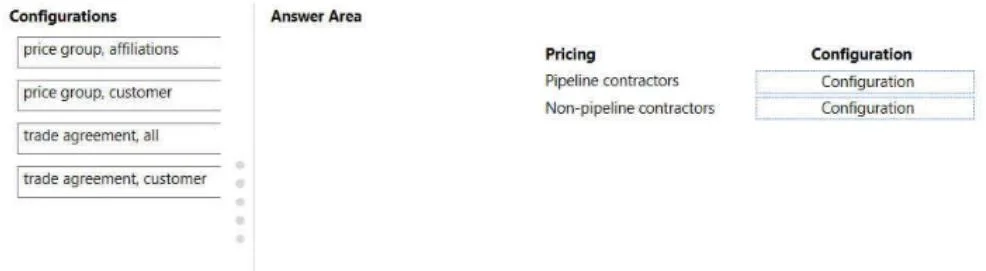
Answer Area
Drag items
Correct arrangement
- price group, affiliations
- trade agreement, customer
Explanation
Dynamics 365 SCM Pricing Configuration - Explained
The Two Scenarios
| Pricing Type | Requirements |
|---|---|
| Pipeline contractors | Special pricing, discounts, price breaks |
| Non-pipeline contractors | No special pricing; prices may change; history must be retained |
Correct Arrangement
1. Pipeline Contractors → price group, affiliations
Why Affiliations?
Affiliations in D365 SCM are a flexible customer categorization mechanism that sits outside the customer record itself. Here's the flow:
- Create a "Pipeline Contractor" affiliation
- Assign a price group to that affiliation
- Link trade agreements with special pricing to that price group
- Assign the affiliation to qualifying customers
This means special pricing activates only when a customer has the affiliation - no other customers are affected. It's the correct tool when a subset of customers earns project-specific or relationship-based pricing without altering their base customer record.
Why not price group, customer?
Assigning a price group directly to the customer record works but is coarse - it doesn't scope the pricing to a specific project or relationship context. Affiliations give you that scoped, opt-in behavior.
2. Non-Pipeline Contractors → trade agreement, customer
Why trade agreements at the customer level?
Trade agreements in D365 SCM are date-ranged records. When a price changes:
- The old trade agreement expires (remains in the system)
- A new trade agreement is created with the new effective date
This is what satisfies the "price history must be retained" requirement - the history is preserved automatically through the date-range structure.
Using the customer scope (rather than "all") ensures pricing is specific to each non-pipeline contractor, which is important since these contractors are explicitly excluded from special pricing.
Why not trade agreement, all?
Setting the account code to "All" would apply the pricing universally - including to pipeline contractors - which could conflict with or undercut their special pricing. Scoping to customer keeps things isolated.
Common Mistakes
- Confusing
affiliationsvs.customeron price groups: Students often think direct customer assignment is more precise. In practice, affiliations are more flexible because you can add/remove the affiliation without touching the customer's base configuration. - Assuming "trade agreement, all" is simpler for non-pipeline contractors: It is simpler to set up but breaks pricing isolation.
- Forgetting that trade agreements are the history mechanism: The price history requirement is the key signal pointing to trade agreements - they inherently log history via effective dates, unlike price group assignments which just overwrite.
Topics
Community Discussion
No community discussion yet for this question.