
MB-330 · Question #367
Drag and Drop Question A cosmetics company uses Dynamics 365 Supply Chain Management. You configure a single legal entity. Items must be created for a new product line of lipsticks. The lipsticks…
The correct answer is Product attributes; Item template. Dynamics 365 SCM - Drag-and-Drop Explained The Two Requirements and Their Answers The question describes two distinct problems that need solving: | Requirement | Correct Configuration | |---|---| | Colors and product lines must be captured consistently per item | Product…
Question
Exhibit
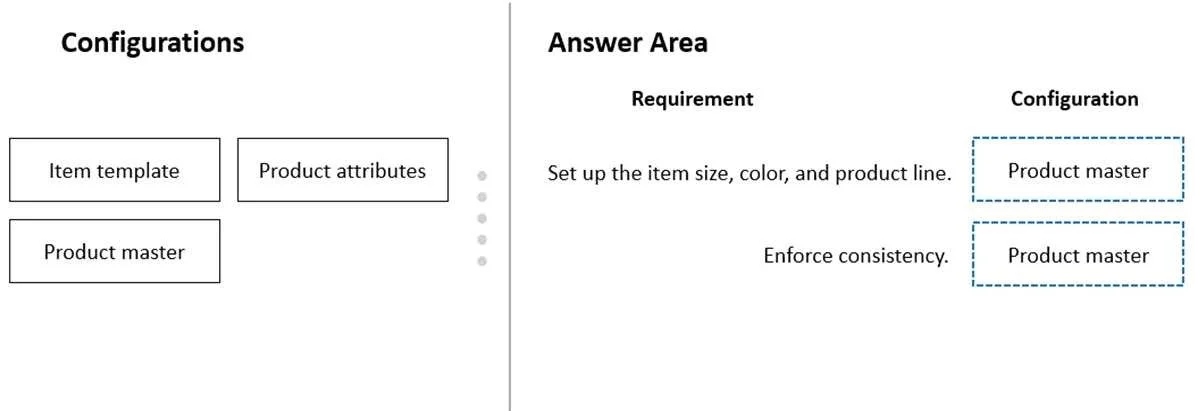
Answer Area
Drag items
Correct arrangement
- Product attributes
- Item template
Explanation
Dynamics 365 SCM - Drag-and-Drop Explained
The Two Requirements and Their Answers
The question describes two distinct problems that need solving:
| Requirement | Correct Configuration |
|---|---|
| Colors and product lines must be captured consistently per item | Product attributes |
| Users historically set up items incorrectly/inconsistently | Item template |
Placement 1 - Product attributes
Why: The lipsticks need color and product line information assigned to their item numbers. Product attributes let you define structured, reusable characteristics (e.g., a "Color" attribute with controlled values: Red, Pink, Nude) that are attached to products or categories. This forces users to select from predefined options rather than free-typing, which directly solves inconsistent value entry.
Product attributes are informational descriptors - they do not affect item numbering or inventory dimensions.
Placement 2 - Item template
Why: The historical problem is that users manually creating items were missing or incorrectly populating fields (item groups, storage dimension groups, posting profiles, etc.). An item template pre-populates those default values every time a new item is created. All lipstick items start from the same baseline, eliminating inconsistency at creation time.
Why "Product master" is wrong here
This is the most common mistake. A product master creates variants (size, color as product dimensions), which is appropriate when variants share a single master item number. However, the question explicitly states each lipstick must have a unique item number - meaning individual released products, not variants. Product master would contradict that requirement.
Key Distinction to Remember
- Product master → one number, many variants via dimensions (size, color as dimensions)
- Product attributes → informational tags on individual items (color, product line as metadata)
- Item template → default field values to prevent setup errors on new items
Topics
Community Discussion
No community discussion yet for this question.