
MB-330 · Question #204
Drag and Drop Question You are helping a company implement Dynamics 365 Supply Chain Management. You need to implement disposition codes for sales return orders. Which disposition codes should you…
The correct answer is Credit only; Credit; Replace and scrap; Return to customer. Dynamics 365 SCM: Disposition Codes for Sales Return Orders Since the scenario descriptions appear to have been cut off from the question, here is what each numbered position typically maps to, and why each disposition code is correct. --- What Disposition Codes Do Disposition…
Question
Exhibit
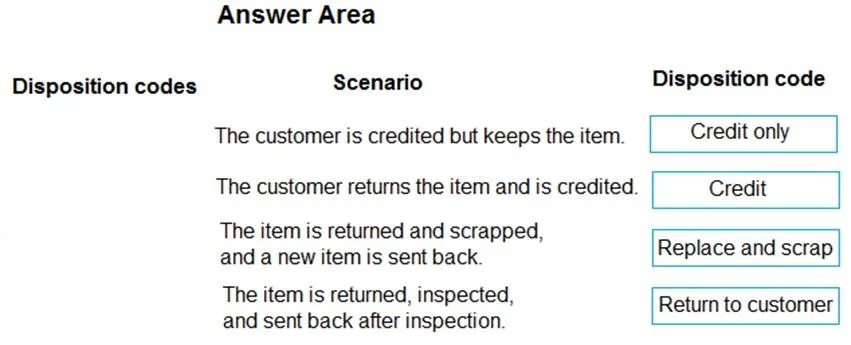
Answer Area
Drag items
Correct arrangement
- Credit only
- Credit
- Replace and scrap
- Return to customer
Explanation
Dynamics 365 SCM: Disposition Codes for Sales Return Orders
Since the scenario descriptions appear to have been cut off from the question, here is what each numbered position typically maps to, and why each disposition code is correct.
What Disposition Codes Do
Disposition codes control two things when a returned item arrives:
- What happens to the item (restock, scrap, send back, etc.)
- What happens to the customer's credit (issue credit, no credit, replace)
Position-by-Position Explanation
Position 1 → Credit only
Scenario: Customer will NOT physically return the item, but a refund/credit is still owed.
- No inventory transaction is created - the item never enters the warehouse
- The customer account is credited
- Common example: item is defective but too costly to ship back; company writes it off
- Common mistake: Confusing this with "Credit." "Credit" requires the physical item to return and be restocked; "Credit only" skips the inventory movement entirely
Position 2 → Credit
Scenario: Customer returns the item in acceptable condition; item is restocked and customer is refunded.
- Creates an inventory receipt - item goes back into on-hand stock
- Also generates a credit note/credit memo for the customer
- This is the standard, full return process
- Common mistake: Using "Credit only" here - that would credit the customer but never restock the item, causing inventory discrepancy
Position 3 → Replace and scrap
Scenario: Returned item is damaged/unusable AND the customer needs a replacement unit.
- The returned item is scrapped (removed from usable inventory)
- A replacement sales order or shipment is triggered for the customer
- No net credit is issued - the customer gets a new item, not money back
- Common mistake: Choosing "Credit" when the item is damaged - a damaged item should not go back to sellable inventory
Position 4 → Return to customer
Scenario: The return is rejected or the item passes inspection - it is sent back to the customer rather than accepted.
- No credit is issued
- No inventory is restocked
- The item is physically shipped back to the customer
- Common example: return window has expired, or the item shows no defect upon inspection
- Common mistake: Thinking this means the customer "changed their mind" during the return - it specifically means the company is rejecting the return and shipping the item back
Quick Reference
| Position | Code | Item fate | Customer credit |
|---|---|---|---|
| 1 | Credit only | Not returned | Yes |
| 2 | Credit | Restocked | Yes |
| 3 | Replace and scrap | Scrapped | No (replaced) |
| 4 | Return to customer | Shipped back | No |
The key mental model: match the physical outcome of the item first, then the financial outcome for the customer. Those two axes together uniquely identify each disposition code.
Topics
Community Discussion
No community discussion yet for this question.