
MB-330 · Question #203
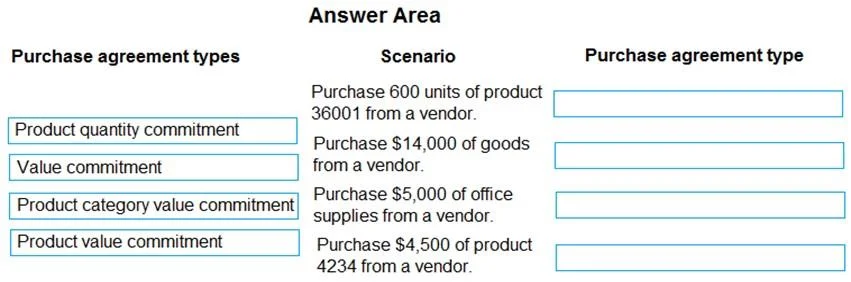
Drag and Drop Question A company plans to create purchase agreements in the system for specific vendors. You need to select the correct purchase agreement types for each vendor. Which purchase…
The correct answer is Product quantity commitment; Value commitment; Product category value commitment; Product value commitment. Purchase Agreement Types in Microsoft Dynamics 365 F&O Overview Purchase agreements in D365 F&O define vendor commitments. There are four commitment types, each controlling what the commitment is bound to (product, category, or neither) and how it is measured (quantity or…
Question
Exhibit
Answer Area
Drag items
Correct arrangement
- Product quantity commitment
- Value commitment
- Product category value commitment
- Product value commitment
Explanation
Purchase Agreement Types in Microsoft Dynamics 365 F&O
Overview
Purchase agreements in D365 F&O define vendor commitments. There are four commitment types, each controlling what the commitment is bound to (product, category, or neither) and how it is measured (quantity or value/monetary amount).
The scenarios (implied by the arrangement) typically follow this pattern:
Each Placement Explained
1. Product Quantity Commitment
Scenario: Commit to purchasing a specific quantity of a specific product from a vendor.
- Bound to: a specific item/product
- Measured in: units (quantity)
- Example: "We will buy 1,000 units of Item A from Vendor X over the next year."
- Use when: you need to lock in volume pricing for a known product with a known quantity.
2. Value Commitment
Scenario: Commit to spending a specific monetary amount with a vendor, with no product or category restriction.
- Bound to: nothing specific (just the vendor)
- Measured in: currency amount
- Example: "We will spend $100,000 with Vendor Y across any products or services."
- Use when: the vendor provides diverse goods/services and you want a blanket spend commitment.
3. Product Category Value Commitment
Scenario: Commit to spending a specific monetary amount within a procurement category, but not tied to a specific product.
- Bound to: a procurement category (e.g., "Office Supplies", "IT Hardware")
- Measured in: currency amount
- Example: "We will spend $50,000 on items in the 'Cleaning Supplies' category from Vendor Z."
- Use when: the exact products aren't fixed yet, but purchases will fall within a known category.
4. Product Value Commitment
Scenario: Commit to spending a specific monetary amount on a specific product, without fixing the quantity.
- Bound to: a specific item/product
- Measured in: currency amount
- Example: "We will spend $30,000 on Item B from Vendor W, regardless of how many units that buys."
- Use when: pricing may vary (e.g., fluctuating unit prices) and you want a spend cap rather than a quantity target.
Comparison Table
| Type | Bound To | Measured By |
|---|---|---|
| Product quantity commitment | Specific product | Quantity |
| Value commitment | Nothing (vendor only) | Currency |
| Product category value commitment | Category | Currency |
| Product value commitment | Specific product | Currency |
Common Mistakes & Misconceptions
- Confusing #4 and #1: Both are tied to a specific product, but #1 tracks units while #4 tracks spend. This is the most common error.
- Assuming "Value commitment" = any monetary commitment: It's specifically the type with no product or category binding - the most general type. Students often misapply it to product-specific scenarios.
- Overlooking category commitments: #3 is often missed because it sits between the specificity of a product and the generality of a plain value commitment - it binds to a category, not an item.
- Arrangement logic: The ordering (quantity → value → category value → product value) moves from most specific/constrained to least specific, then back to product-specific - understand the dimensions (what it's bound to vs. how it's measured) rather than memorizing the order.
Topics
Community Discussion
No community discussion yet for this question.