
MB-310 · Question #166
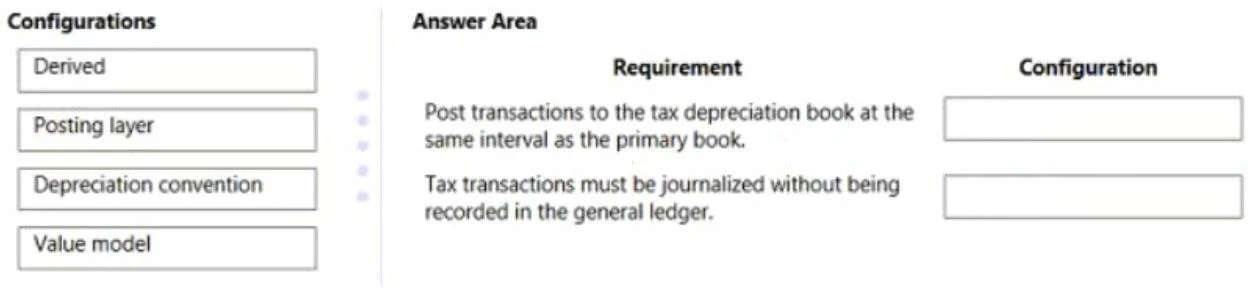
Drag and Drop Question A company is implementing Microsoft Dynamics 365 Finance. The company plans to implement the Fixed asset module. You have the following requirements: - Post transactions to…
The correct answer is Derived; Posting layer. D365 Finance - Fixed Asset Books Configuration --- Requirement 1: Post transactions to the tax depreciation book at the same interval as the primary book Answer: Derived A derived book is a secondary book that is linked to a primary book. When any transaction (acquisition…
Question
Exhibit
Answer Area
Drag items
Correct arrangement
- Derived
- Posting layer
Explanation
D365 Finance - Fixed Asset Books Configuration
Requirement 1: Post transactions to the tax depreciation book at the same interval as the primary book
Answer: Derived
A derived book is a secondary book that is linked to a primary book. When any transaction (acquisition, depreciation, disposal, etc.) is posted to the primary book, D365 automatically creates and posts the same transaction to all derived books simultaneously - no manual intervention required.
This is precisely the mechanism for ensuring the tax book mirrors the primary book's posting schedule. You configure this by:
- Creating a secondary book for tax depreciation
- Linking it to the primary book via the Derived books FastTab
Why not "Value model"? Value model is legacy AX 2012 terminology. In D365 Finance, books replaced value models and depreciation books - it is not a distinct configuration option for this requirement.
Requirement 2: Tax transactions journalized without being recorded in the general ledger
Answer: Posting layer
Every fixed asset book is assigned a posting layer. The three options are:
| Layer | General Ledger Impact |
|---|---|
| Current | Posts to GL (standard financial reporting) |
| Operations | Does NOT post to GL |
| Tax | Does NOT post to GL |
By assigning the tax book to the Tax (or Operations) posting layer, transactions are fully journalized and trackable within the fixed asset module but are invisible to the general ledger. The GL only reflects the Current layer.
Why not "Depreciation convention"? Depreciation conventions (half-year, full-month, mid-quarter) control when depreciation begins and ends within a period - they have no bearing on GL visibility.
Common Misconceptions
- Derived ≠ manual synchronization. Some assume you need to run a batch or manually post the tax book. The derived relationship automates this entirely.
- Posting layer ≠ posting profile. Posting profiles define which GL accounts receive entries. Posting layer controls whether entries reach the GL at all.
- "Value model" is a trap answer. It appears plausible to candidates familiar with older AX versions, but it is not a valid D365 Finance configuration option in this context.
- Both requirements work together: a book can be both derived (synced automatically) and assigned to the Tax posting layer (excluded from GL) - these are complementary settings on the same book.
Topics
Community Discussion
No community discussion yet for this question.