Question
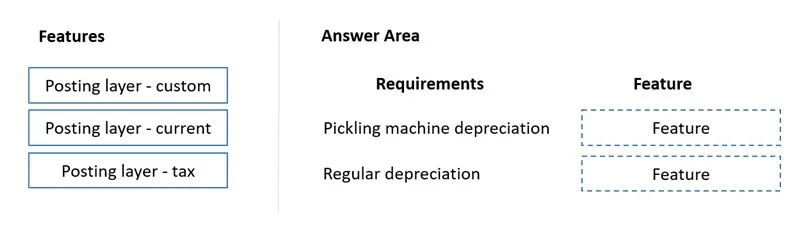
Case Study 2 - Munson Background Munson's Pickles and Preserves Farm grows and distributes produce, jellies, and jams. The company's corporate headquarters is located in Dallas, TX. Munson's has one operations center and seven regional distribution centers in the United States. The company has two wholly owned subsidiaries that operate in Canada. The Canadian entity owns an entity in France. Munson's plans to expand into Latin America by purchasing the last 25 percent of a subsidiary that they own in Costa Rica. This process is expected to complete within the next two years. The company plans to implement Dynamics 365 Finance and Dynamics 365 Supply Chain to meet their growing business needs. Current environment. General Munson's uses a mix of internally-developed legacy systems that handle their finance and distribution activities. The company has an isolated CRM system. Both Canadian subsidiaries have two departments: marketing and operations. Financial reporting is difficult due to data residing in disparate systems. Financial reporting is currently performed by using Microsoft Excel. Pre-orders in the current system are difficult to track because the order management system is not integrated with the finance system. Pickle sales post to one revenue account, but this does not allow for targeted reporting by pickle cut and type. Current environment. Organization The following chart shows Accounting/Reporting Currencies and Tax ID, if applicable. Typically, vendor invoices are received prior to receipt of product. The following fixed assets are sold for a loss: 1. BUILD-100 2. CAR-1233 At the regional distribution centers, the value for physical inventory does not match the inventory in the financial system. Munson's rents their corporate office. Rent is not paid by purchase order. Rent is due once a quarter. Allocations are performed manually. Barrels are inventoried by site and warehouse. Munson's has multiple depreciation and tax books for all of their fixed asset equipment. Budgets are posted at the department level for each legal entity. Requirements. Sales Customers should be able to pre-order for fall release of pickles. Three-way matching must be enforced for all purchases. Fixed asset sale transactions require a ledger account entered at the time of transaction. Fixed assets purchased must be automatically created in fixed asset module. This includes inventory items and write in purchase orders/non-inventoried items. One dollar from every sale needs must be tracked and donated at the end of each month to a charitable organization. Purchasing budgets must be enforced at the main account level. Requirements. Finance Accounts payable must be able to enter vendor invoices on the day they were received to be settled against when product is received. Accounts payable must be able to enter vendor invoices to accrue expense without specifying a purchase order at the time of entry. Postage expenses must be split evenly across the regional distribution centers automatically. Administrative expenses must be distributed across the regional distribution centers by percentage of fulfillment orders monthly. Pickling machines depreciation must be uniquely recorded for visibility but not post to the ledger. Issues During implementation testing, User1 indicates that after packing slips are generated for purchase orders, there are no ledger postings. User2 indicates that fixed assets purchased on a purchase order do not show up in the Fixed Assets module. User3 reports that they are seeing inconsistent application of the one-dollar donation from all sales orders. User4 in the Canadian subsidiary is able to purchase supplies for marketing despite exceeding the marketing department budget. User5 reports that when purchasing a non-inventoried computer, the system is automatically assigning it to the buildings fixed asset group. Drag and Drop Question You need to select the functionality to meet the requirement. Which features should you use? To answer, drag the appropriate features to the correct requirements. Each feature may be used once or not at all. You may need to drag the split bar between panes or scroll to view content. NOTE: Each correct selection is worth one point. Answer:
Explanation
Dynamics 365 Finance - Fixed Asset Posting Layers Explained
Context from the Case Study
Two relevant facts drive this question:
- Munson's has multiple depreciation and tax books for fixed asset equipment.
- Pickling machines depreciation must be uniquely recorded for visibility but NOT post to the ledger.
The drag-and-drop is asking you to match the correct posting layer to the two books that do post to the ledger.
How Posting Layers Work in D365 Finance
Fixed asset books (value models) are assigned a posting layer, which determines which "slice" of the general ledger they write to. This allows multiple depreciation calculations to coexist without interfering with each other.
| Posting Layer | What it does |
|---|
| Current | Posts to the main general ledger - standard GAAP/book depreciation |
| Tax | Posts to a separate tax layer - used for tax-basis depreciation |
| Custom | Posts to a custom layer - used for specialized internal tracking |
Why the Answers Are What They Are
Slot 1 → Posting layer - Current
This covers standard book depreciation (GAAP/IFRS). The "current" layer is the primary financial reporting layer and is the correct choice for the depreciation book that drives financial statements. Every company needs at least one book here.
Slot 2 → Posting layer - Tax
Munson's explicitly has tax books in addition to their regular depreciation books. The tax posting layer keeps tax-basis depreciation calculations separate from book depreciation, satisfying tax authority reporting without distorting the primary financial statements.
Why "Posting layer - Custom" is NOT Used
This is the key misconception trap. You might think "custom" maps to the pickling machines requirement ("uniquely recorded but not post to the ledger"), but that reasoning is wrong:
Custom still posts to the general ledger - just to a custom layer of it.
To meet the pickling machine requirement (record for visibility, no ledger posting), you configure that depreciation book with "Post to general ledger" = No in the book setup. This is a book-level flag, not a posting layer choice. No posting layer option from the available items satisfies "does not post to the ledger," so custom is a deliberate distractor.
Common Mistakes
- Selecting "Custom" for the pickling machines - Tempting, but custom still writes to the ledger. The correct mechanism is disabling ledger posting on the book itself, not a layer choice.
- Confusing "Tax" layer with "no tax impact" - The tax posting layer creates tax-basis entries; it doesn't suppress them.
- Thinking only one book/layer is needed - Munson's explicitly has multiple books, so both Current and Tax layers are actively required.