nerdexam
Microsoft

MB-310 · Question #138

Case Study 3 - Alpine Ski House Background Alpine Ski House has three partially owned franchises and 10 fully owned resorts throughout the United States and Canada. Alpine Ski House's percentage…

The correct answer is Value; Product quantity. Drag-and-Drop Explanation: Purchase Agreement Commitment Types Background: What Are Commitment Types? In Dynamics 365 Finance, Purchase Agreements use commitment types to define the nature of a contractual obligation with a vendor. The four types are: | Type | Meaning |…

Implement and manage accounts payable and expenses

Question

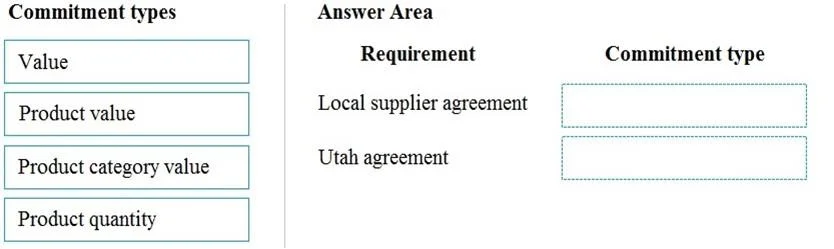
Case Study 3 - Alpine Ski House Background Alpine Ski House has three partially owned franchises and 10 fully owned resorts throughout the United States and Canada. Alpine Ski House's percentage ownership of the franchises is between two and 10 percent. Alpine Ski House is undergoing an implementation of Dynamics 365 Finance and Dynamics 365 Supply Chain Management to transform their financial management and logistics capabilities across the franchises. Implementation is complete for Alpine Ski House's corporate offices, two US franchises, and one Canadian franchise. The remaining franchises are in varying stages of the implementation. Two new resort projects are in the budget planning stages and will open in the next fiscal year. Current environment Organization and general ledger Each franchise is set up as a legal entity in Dynamics 365 Finance. Alpine Ski House Corporate uses financial dimensions for their fully owned resorts. Each resort is a financial dimension named resort. Each fully owned resort has two divisions: marketing and operations. Only Profit and Loss account postings require the division dimension. Corporate handles the advertising and administration of the fully owned resorts. Corporate uses Dynamics 365 Project Management and Accounting to manage construction of new resorts. Budgeting Organizational budgeting is decentralized but rolls up to one organizational corporate budget. Each resort manager performs budgeting in Dynamics 365 Finance. Budget preparation begins this month. All operational resorts will submit their budgets in two weeks. Sales and tax Sales tax is configured and used by all resorts that operate in the United States. You configure one US sales tax vendor account and assign the vendor account to the settlement periods for reporting. You use accounts receivable charges to track donations. Existing purchasing contracts Each franchise resort has an individual contract with a local supplier of their choosing to purchase at least $10,000 worth of suppliers during the calendar year. The franchise resorts in one US state receive a two percent discount on meat and vegetable purchases in excess of $8,000 per year. A franchise resort in Utah has agreed to purchase 1,000 units of beef at market price from a local supplier. Alpine Ski House uses a vendor collaboration portal to track purchase orders and requests for quotes. Vendors request access to the vendor collaboration portal by using a workflow which runs on a nightly schedule. Intercompany setup Vendor123 resides in US franchise Company1 and is set up for intercompany transactions. Customer345 resides in Canada franchise Company1 and is set up for intercompany transactions. Requirements Franchises Each franchise must pay two percent of monthly sales to Alpine Ski House Corporate. Each franchise must report their own financials to Alpine Ski House Corporate monthly. US franchises require a three-way-match on all purchases, with a 1-percent price tolerance. Canadian franchises require a three-way-match on all purchases except paper products, which have a 10-percent price tolerance. Corporate Advertising costs must be balanced across the 10 resorts monthly. These costs must be split across the 12 resorts once construction of the final two resorts is completed. Administration costs must be split across the 10 resorts proportional to the amount of sales generated. One percent of all pack and individual ski pass sales must be donated quarterly to an environmental protection organization. The finance department must be able to see purchasing contracts and discounts for vendors based on volume spend. Employees All employee expense reports that contain the word entertainment must be reviewed for the audit purposes. If a journal is posted incorrectly, the entire journal and not just the incorrect line must be fully reversed for audit purposes. Resorts All resorts must use Dynamics 365 Finance for budgeting and must first be approved by the regional manager. Purchased fixed assets must automatically be acquired at product receipt. Issues User1 reports that irrelevant dimensions display in the drop down when entering a General journal. User2 reports that dimension 00 is being used for all balance sheet accounts. User3 tries to generate the quarterly sales tax liability payment for a specific state but does not see any payables available for that state's vendor. User4 receives a call from a vendor who cannot access the vendor collaboration portal but needs immediate access. User5 notices a large amount of entertainment expenses being posted without an audit review. User6 needs to have visibility into the increase in budget that is necessary to staff the two new resorts opening next year. User7 needs to use Dynamics 365 Finance for situational budgeting planning with the ability to increase and decrease the existing plans by certain percentages. User8 made a mistake while posting a 1,000-line journal and reverses the entire journal but cannot find the lines that included errors during the reversal. User9 made a mistake while posting a 55-line journal and reverses the entire journal. User10 realizes that the purchase of five new computers did not acquire five new fixed assets upon receipt. Drag and Drop Question You need to configure the system to for existing purchasing contracts. Which commitment types should you use? To answer, drag the appropriate commitment types to the correct requirements. Each commitment type may be used once, more than once, or not at all. You may need to drag the split bar between panes or scroll to view content. NOTE: Each correct selection is worth one point. Answer:

Exhibit

MB-310 question #138 exhibit

Answer Area

Drag items

ValueProduct valueProduct category valueProduct quantity

Correct arrangement

  • Value
  • Product quantity

Explanation

Drag-and-Drop Explanation: Purchase Agreement Commitment Types

Background: What Are Commitment Types?

In Dynamics 365 Finance, Purchase Agreements use commitment types to define the nature of a contractual obligation with a vendor. The four types are:

TypeMeaning
ValueCommit to spend a minimum dollar amount - no specific product required
Product valueCommit to spend a minimum dollar amount on a specific product
Product category valueCommit to spend a minimum dollar amount within a product category
Product quantityCommit to purchase a specific quantity of a specific product

The Two Contracts in the Case Study

The case study describes two distinct purchasing contracts that require configuration:


Contract 1 → Value

"Each franchise resort has an individual contract with a local supplier to purchase at least $10,000 worth of supplies during the calendar year."

  • The obligation is purely monetary - a minimum spend of $10,000
  • There is no restriction on product type or category; the resort can buy any supplies from that supplier
  • This maps directly to the Value commitment type: a dollar-amount commitment with no product specificity

Contract 2 → Product quantity

"A franchise resort in Utah has agreed to purchase 1,000 units of beef at market price from a local supplier."

  • The obligation is defined by a specific product (beef) and a specific quantity (1,000 units)
  • The price is at market rate (not a fixed price), but the quantity commitment is firm
  • This maps directly to the Product quantity commitment type: a unit-based commitment tied to a specific item

Why Not the Other Two Types?

Product value - Not used here because no contract says "spend $X on product Y." The beef contract is quantity-based, not value-based.

Product category value - This might tempt you for the "meat and vegetable discount" mentioned in the case study, but that discount is a trade agreement/discount, not a purchasing commitment. It describes a threshold for receiving a discount, not a contractual obligation to purchase a set amount. It is configured separately (e.g., via trade agreement journals), not as a purchase agreement commitment type.


Common Mistakes

  • Confusing the meat/vegetable discount with Product category value: The $8,000 meat/vegetable threshold triggers a discount but is not a purchase commitment the company is obligated to meet - it's a pricing rule.
  • Using Product value for the beef contract: The Utah beef deal specifies units, not a dollar spend, so Product quantity is correct even though there is an implicit dollar value involved.
  • Using Value for both contracts: The beef contract has a specific product and quantity, which narrows it to Product quantity - Value is too broad.

Topics

#purchase agreement#commitment type#product quantity#vendor contract

Community Discussion

No community discussion yet for this question.

Full MB-310 Practice