
MB-310 · Question #443
Drag and Drop Question A company is implementing the Expense management module in Dynamics 365 Finance. The company has outlined the following business requirements: - Standardize expense…
The correct answer is Shared category; Expense policy; Main account. Dynamics 365 Finance - Expense Management Configuration Explained The Business Requirements Mapped | # | Business Requirement | Configuration | |---|---|---| | 1 | Standardize expense classifications across all legal entities | Shared category | | 2 | Allow each legal entity to…
Question
Exhibit
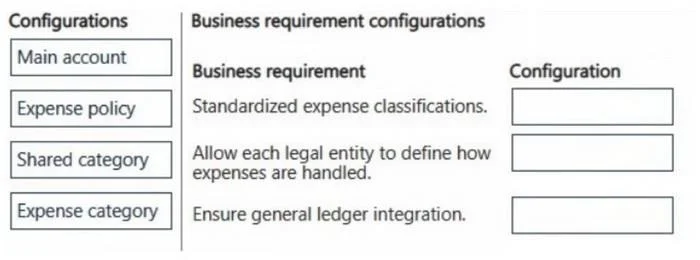
Answer Area
Drag items
Correct arrangement
- Shared category
- Expense policy
- Main account
Explanation
Dynamics 365 Finance - Expense Management Configuration Explained
The Business Requirements Mapped
| # | Business Requirement | Configuration |
|---|---|---|
| 1 | Standardize expense classifications across all legal entities | Shared category |
| 2 | Allow each legal entity to define how expenses are handled locally | Expense policy |
| 3 | Ensure financial integration between expense claims and the general ledger | Main account |
Why Each Configuration Goes There
1. Shared Category → Standardize classifications across all legal entities
A shared category in D365 Finance is defined at the organizational level and is available to all legal entities simultaneously. It acts as the master classification list, ensuring every entity uses the same taxonomy (e.g., "Travel," "Meals," "Accommodation"). Because it lives outside any single legal entity, it enforces consistency enterprise-wide.
Common mistake: Choosing Expense category here. Expense categories are local to each legal entity and link down to a shared category. They are the per-entity customization layer, not the standardization layer.
2. Expense Policy → Allow each legal entity to define how expenses are handled locally
An expense policy is configured per legal entity in D365 Finance. It controls local rules: spending limits, mandatory fields, per-diem rates, approval thresholds, and receipt requirements. Because each legal entity can have its own policy, this directly satisfies the requirement to allow local definition of expense handling.
Common mistake: Thinking expense policy is global. It is scoped to the legal entity, which is precisely why it fits this requirement.
3. Main Account → Ensure financial integration between expense claims and the general ledger
A main account is the General Ledger account to which expense transactions post. When an expense category (or shared category) is mapped to a main account, the system knows exactly which GL account to debit/credit when an expense claim is approved and posted. Without this mapping, expense claims have no path into the ledger.
Common mistake: Overlooking this step and assuming posting happens automatically. The main account linkage is what creates the bridge between the Expense sub-ledger and the General Ledger.
Why "Expense Category" Is Not Used Here
Expense category is a valid D365 concept but is a local extension of a shared category - it adds entity-specific details (tax groups, posting rules). None of the three requirements specifically call for entity-level category customization; they call for standardization (shared category), local policy rules (expense policy), and GL integration (main account). Expense category is the distractor in this question.
Topics
Community Discussion
No community discussion yet for this question.