nerdexam
Microsoft

MB-230 · Question #192

Drag and Drop Question You are configuring URS functionality for a company to manage resource scheduling. The configuration must include the following setup: - Set availability for a new part-time…

The correct answer is Resource user; Bookable resource calendar; Business closure. URS Configuration: Drag-and-Drop Explained This question is about Universal Resource Scheduling (URS) in Microsoft Dynamics 365, specifically which record types solve each scheduling requirement. --- Requirement 1 → Resource user A Resource user record is what you create to…

implement scheduling

Question

Drag and Drop Question You are configuring URS functionality for a company to manage resource scheduling. The configuration must include the following setup:

  • Set availability for a new part-time employee.
  • Ensure new full-time employee resources are bookable during standard

business hours only.

  • Ensure nothing is booked on national holidays.

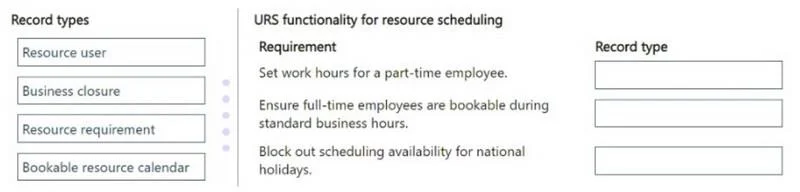
You need to complete the configuration to meet the requirements. Which record types should you configure? To answer, select the appropriate component for each requirement. NOTE: Each correct selection is worth one point. Answer:

Exhibits
MB-230 question #192 exhibit 1
MB-230 question #192 exhibit 2

Answer Area

Drag items

Resource userBusiness closureResource requirementBookable resource calendar

Correct arrangement

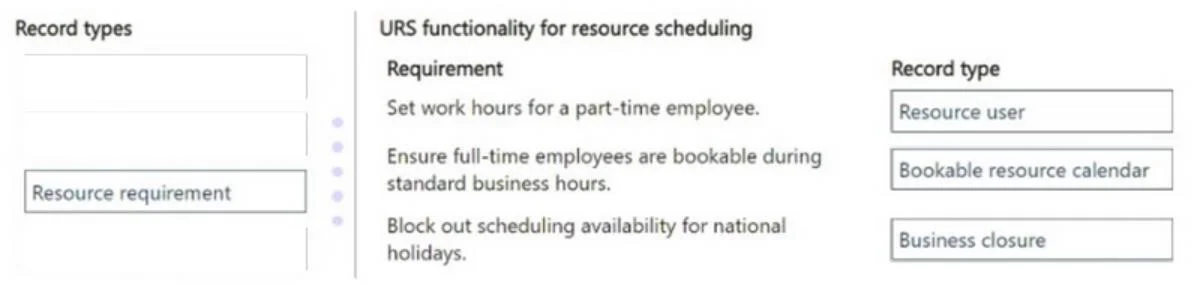
  • Resource user
  • Bookable resource calendar
  • Business closure

Explanation

URS Configuration: Drag-and-Drop Explained

This question is about Universal Resource Scheduling (URS) in Microsoft Dynamics 365, specifically which record types solve each scheduling requirement.


Requirement 1 → Resource user

A Resource user record is what you create to represent a person (employee) as a schedulable entity in URS. For a part-time employee, this is the starting point - you create the resource user record and define their working hours directly on it (e.g., 3 days/week, specific hours). Without this record, the person simply doesn't exist in the scheduling system.

Common misconception: People confuse this with a Bookable Resource Calendar. The resource user record is the resource itself - the calendar modifies its hours, but you can't set availability at all without first having the resource record. For part-time, the hours are typically set directly on the resource or via a personal calendar.


Requirement 2 → Bookable resource calendar

A Bookable resource calendar defines when a resource is available for booking. For a full-time employee restricted to standard business hours (e.g., 9–5, Mon–Fri), you assign or configure a calendar that enforces those hours. This prevents bookings outside that window.

Common misconception: This is not the same as a Business Closure. A calendar governs routine/recurring working hours. Business closures handle exceptions (one-off days), not the standard schedule.


Requirement 3 → Business closure

A Business closure record marks specific dates (e.g., national holidays) as unavailable across the board. It blocks bookings system-wide on those dates, regardless of individual resource calendars.

Common misconception: People sometimes think they need to manually edit each resource's calendar for holidays. Business closures are the correct tool - they apply globally and centrally, so you don't have to update every resource individually.


Why "Resource requirement" is the distractor

A Resource requirement represents the demand side - it's a request for a resource to fulfill a job/task. It has nothing to do with configuring availability or blocking time. It's the wrong layer entirely for this scenario.


Summary Table

RequirementRecord TypeWhy
Part-time employee availabilityResource userCreates the schedulable entity with its hours
Full-time, business hours onlyBookable resource calendarDefines recurring working hour windows
Block national holidaysBusiness closureSystem-wide date-based booking blocks

Topics

#Universal Resource Scheduling#bookable resource calendar#business closure#resource availability

Community Discussion

No community discussion yet for this question.

Full MB-230 Practice